Blog Archives

Lewin’s Honeyeater, dark green and yellow
I watched this little honeyeater for a while, but it was adept at keeping parts of itself hidden. Still, I got a shot of the bird drinking from some bell flowers:

The bird is overall quite dark in colour, with olive-green back and wings and a dark head. A light yellow streak runs alongside its beak — I think this is called the gape. Behind the eye is a yellow tuft covering the bird’s ear.
Here’s a photo from a slightly different angle:

This is only the second time I’ve spotted a Lewin’s Honeyeater. The other one was nearby, just over a year ago (June 2023).
Common name: Lewin’s Honeyeater
Scientific name: Meliphaga lewinii
Approximate length: 19-22 cm
Date spotted: 15 August 2024 (winter)
Location: Just outside Manly Dam Reserve, New South Wales, Australia: 33°46’55.6″S 151°15’26.9″E

My first Lewin’s Honeyeater
Australia hosts several types of honeyeater, and I’ve spotted a few of them over the lifetime of this blog. Recently I saw my very first Lewin’s Honeyeater:
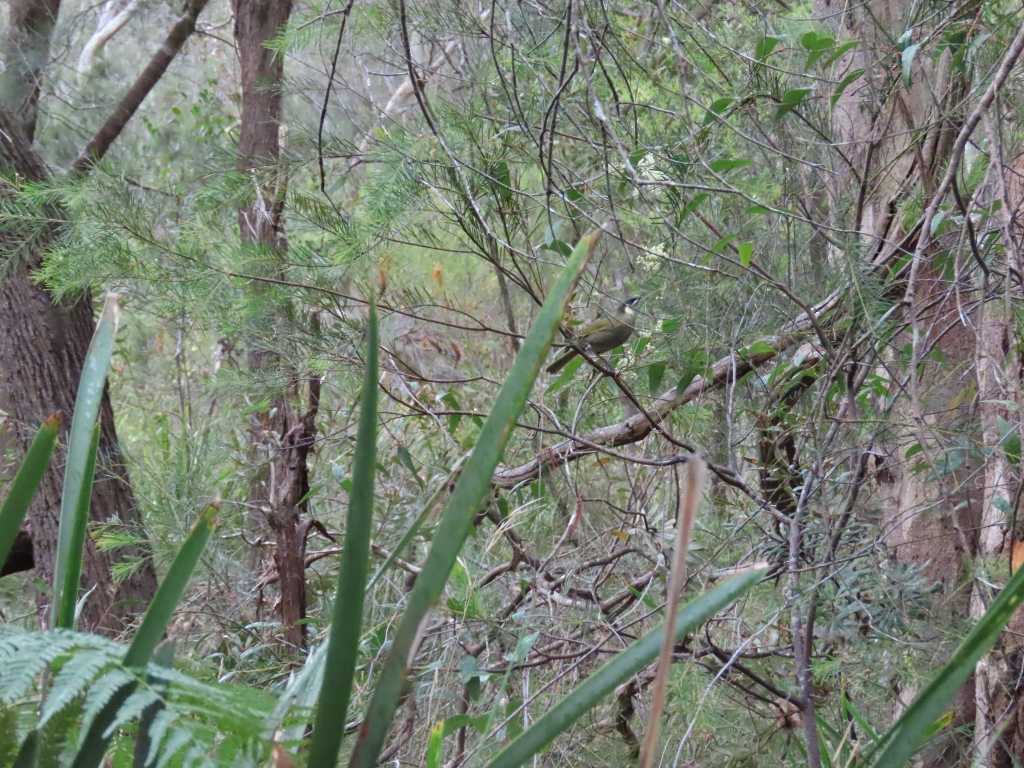
Lewin’s Honeyeater is a medium-sized bird. As is the case with other honeyeaters, nectar forms a major part of their diet. They also eat fruits and insects. They have a distinctive, crescent-shaped yellow ear patch as well as a light yellow stripe under each eye.
According to my bird book, they’re “abundant”, especially in the wetter areas of eucalypt forests. I’ll keep a look out now that I know they’re around.
Common name: Lewin’s Honeyeater
Scientific name: Meliphaga lewinii
Approximate length: 19-22 cm
Date spotted: 5 June, 2023 (winter)
Location: Manly Dam Reserve, New South Wales, Australia: 33°46’47.6″S 151°14’53.2″E


 Sydney Birder