Category Archives: nest

Magpie-lark nest with chicks
A couple of days ago, I spotted a Magpie-lark having a quick cicada snack. Today, back in the same area of Manly Dam, there was more activity in the Magpie-lark community. It turns out that the birds have a nest nearby, and the adults are busily feeding the chicks.
In this video, the chicks’ heads pop up when the adult arrives to feed them. When the adult leaves, the babies stretch the necks, begging for more.
As you can tell, the nest was quite far away from my vantage point, and my camera’s zooming powers are stretched to the utmost. Still, you can see what’s happening.
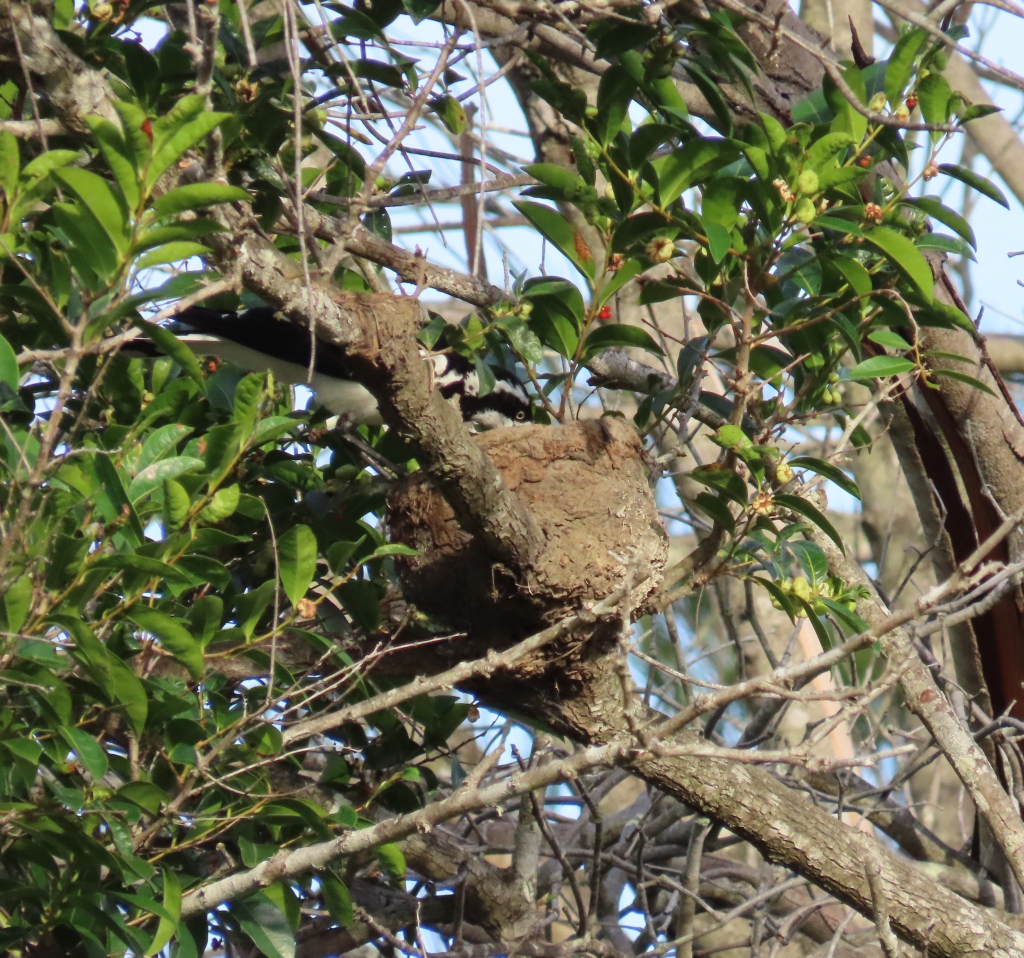
Here’s a still shot of the nest with an adult Magpie-lark peering down into it. The adult is a female, as it has a white throat. You can see the white underbelly of the bird towards the left, the black wings above, and then, on the right of the branch, the black-and-white head with the bird’s eye just above the rim of the nest:
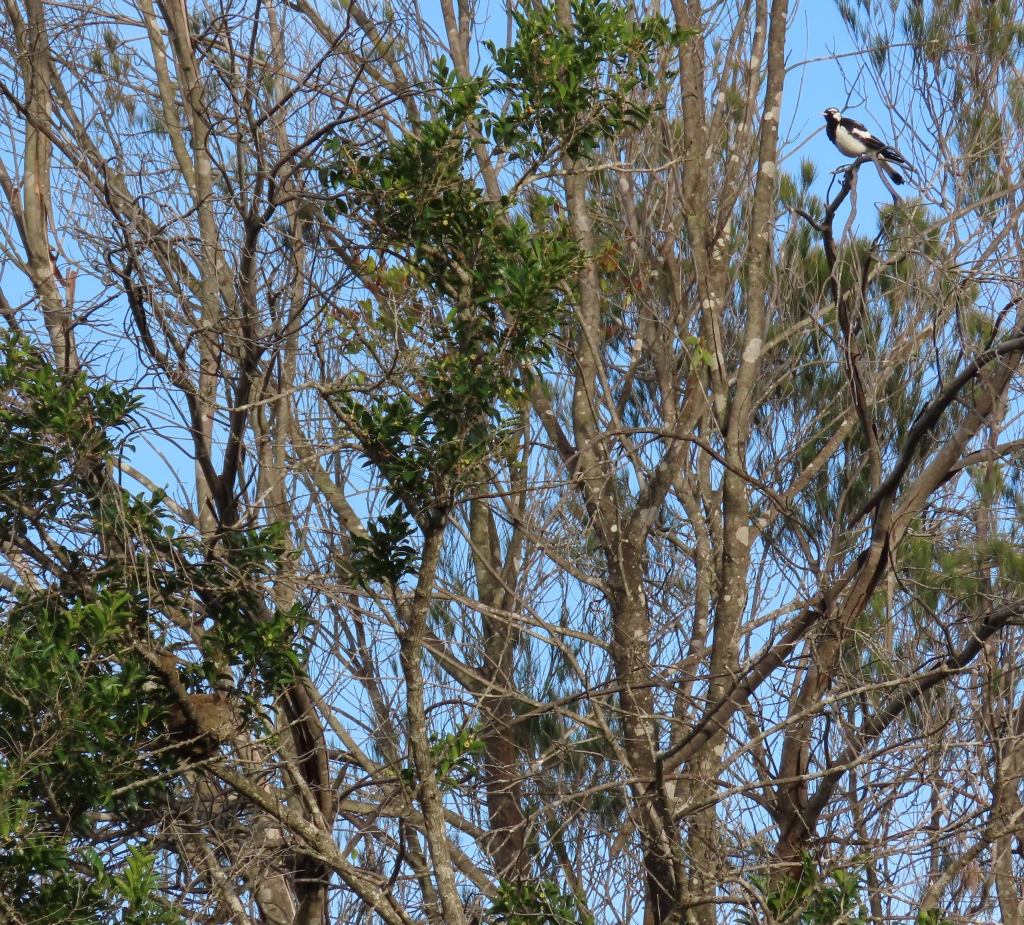
Gathering food and feeding babies is hard work. The adults often take a breather within sight of the nest, but out of sight of the babies, so that the babies don’t squawk for food. Here’s a male adult (black throat) at top right of the photo, with the nest near the bottom left:
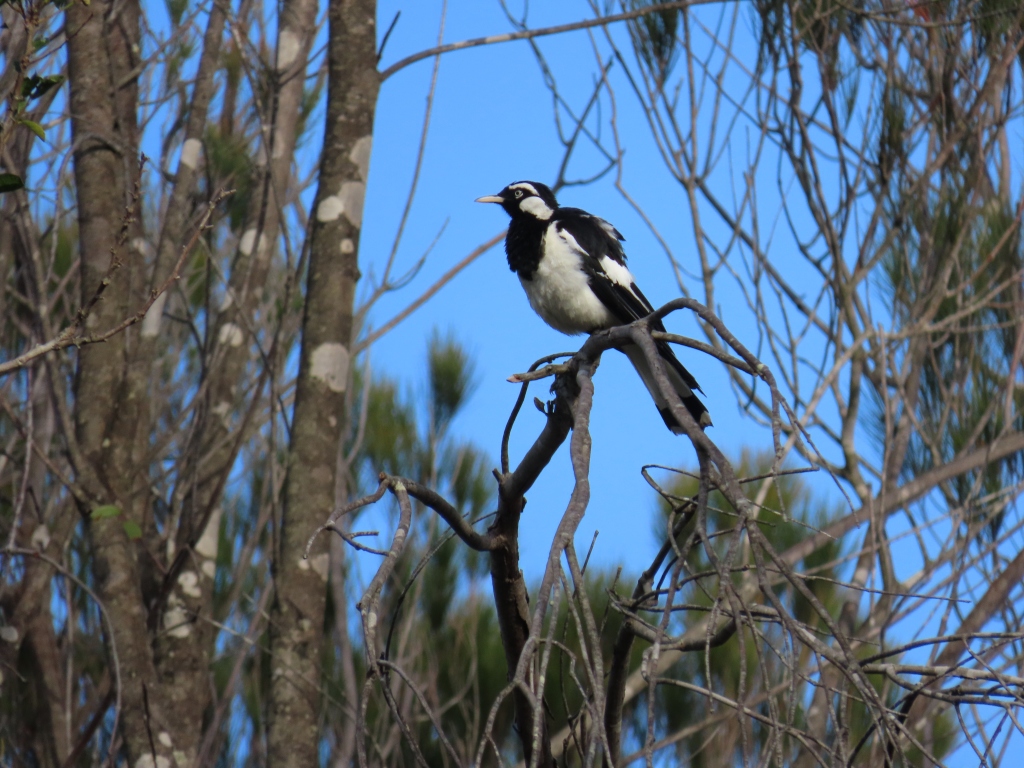
Here’s a closeup of the adult taking a breather:
Common name: Magpie-lark, also called a Peewee or a Mudlark
Scientific name: Grallina cyanoleuca
Approximate length: 30 cm
Date spotted: 7 January 2024 (summer)
Location: Manly Dam National Park, New South Wales, Australia: 33°46’35.5″S 151°14’50.3″E

Red-browed Finch builds nest in lichen-covered tree
A little Red-browed Finch wrangles a long supple twig into its nest. The nest is in a lichen-covered tree, making a pretty scene with the red flashes on the bird against the green of the lichen.
The nest is barrel-shaped, bigger than I’d expect for such a small bird, with a small hole at one end:
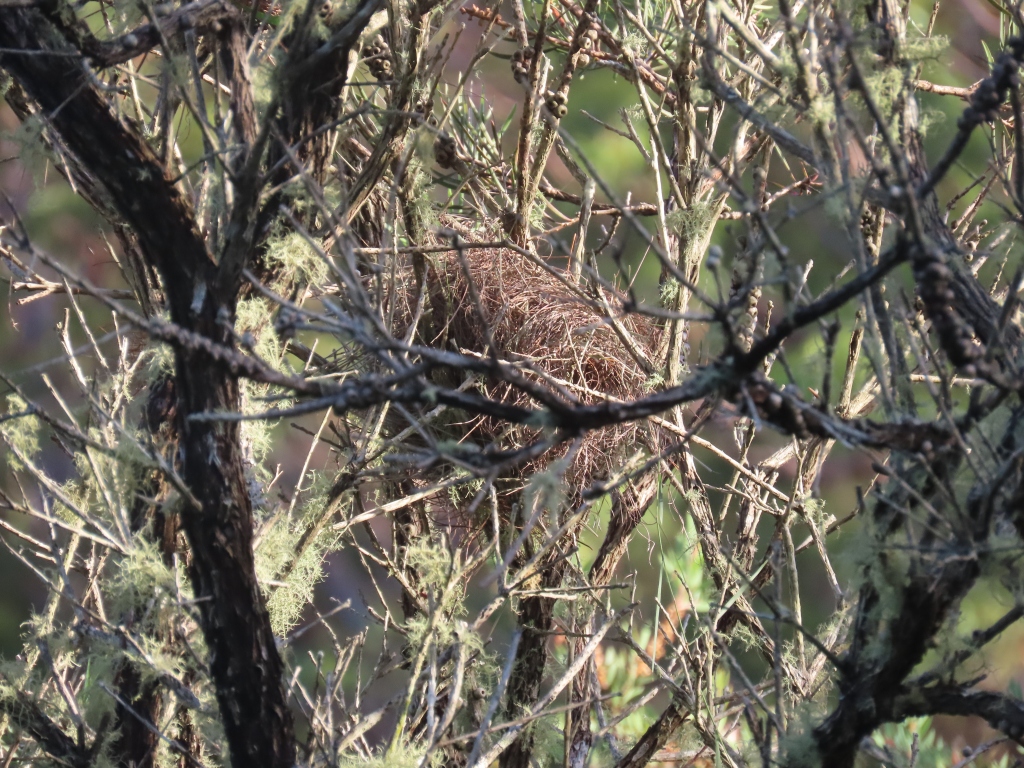
The tree is in a swampy area of Manly Dam. When the weather is wet and humid, the lichen flourishes, as now:
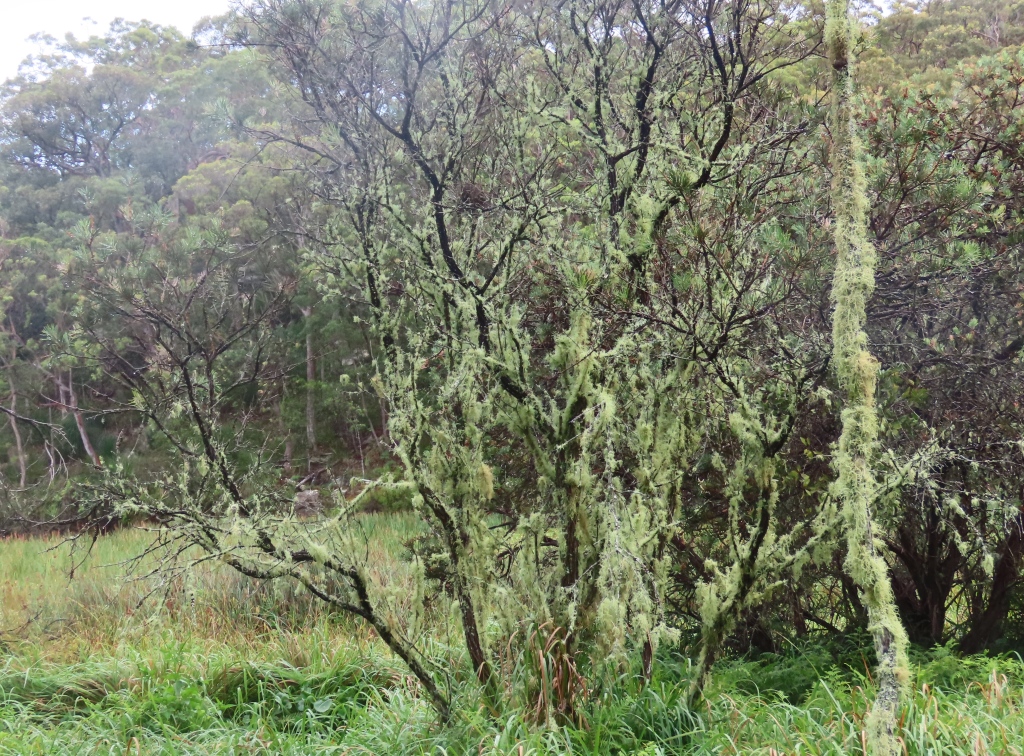
In the dry summer heat yet to come, the lichen will die away, but it always seems to come back.
Common name: Red-browed Finch
Scientific name: Neochmia temporalis
Approximate length: 12 cm
Date spotted: 22 December 2023 (summer)
Location: Manly Dam park, near Sydney: 33°46’23.1″S 151°14’35.9″E

Pardalotes nesting on a Sydney beach
Pardalotes are unusual in that they build their nests underground, usually at around ankle height. This morning I spotted a couple of the birds flitting around a grassy bank on a beach in Sydney Harbour. With a bit of patience and the benefit of my camera’s super zoom, I was able to see the birds going in and out of their nesting tunnel.
The next video shows the male bird waiting on a tree branch until the coast is clear, then flitting off towards the nest:
Here’s the female, also checking for danger near the nest:
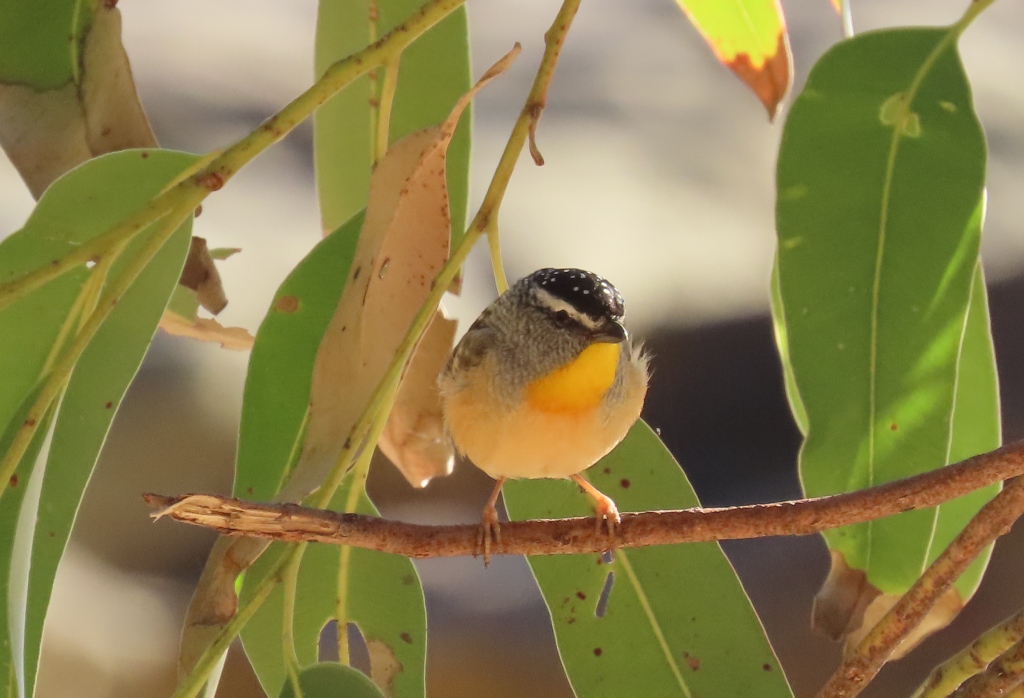
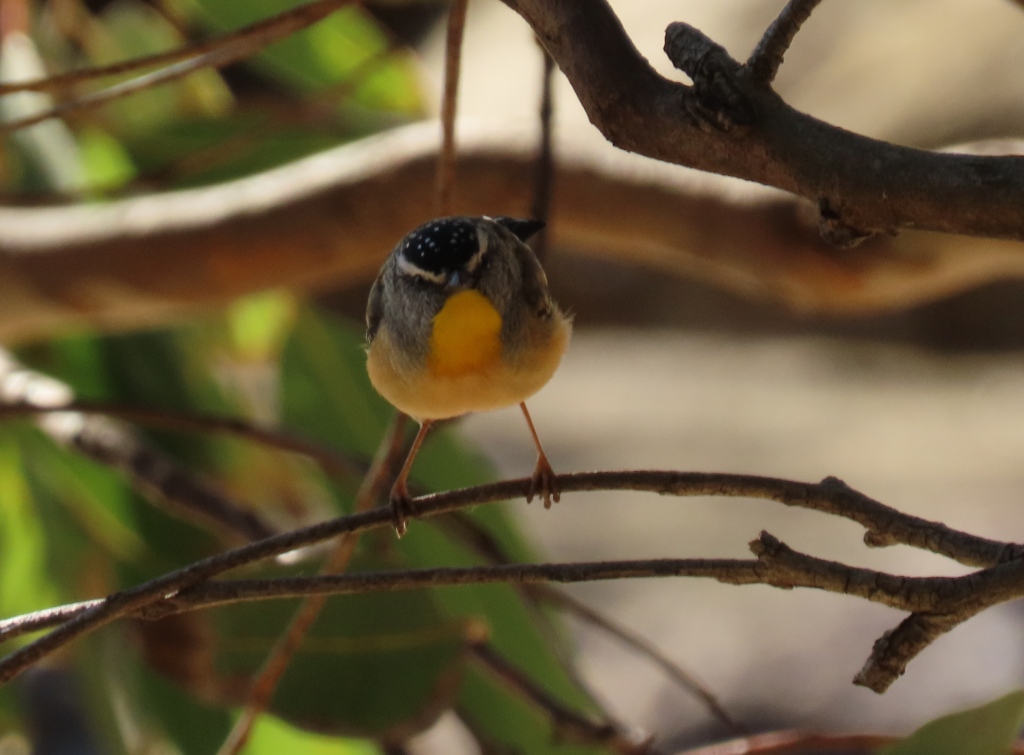
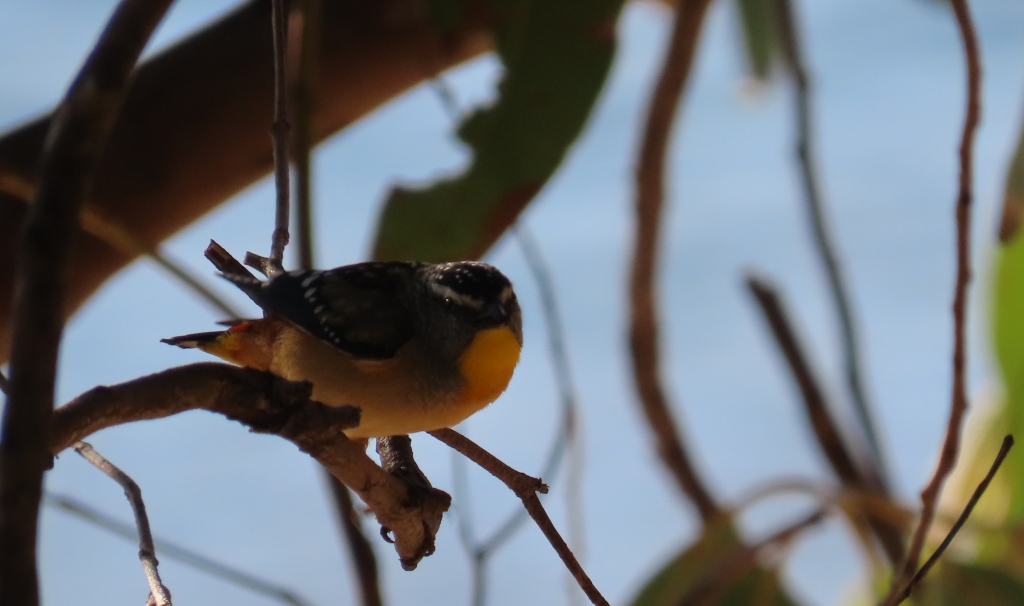
These are Spotted Pardalotes, also called Diamondbirds. They’re one of the smallest of Australian birds, at approximately 10 cm from head to tail. I’m often surprised at how unbothered they seem by my presence.
The female has a pale, faun-coloured chest. Her head and back are prettily dotted with spots, and her tail is aflame with red and yellow.

The male has an orange-yellow chest. The white stripes across its eyes are more pronounced than those of the femail, and there’s more black on the head and back, making the white spots stand out.
Common name: Spotted Pardalote or Diamondbird
Scientific name: Pardalotus punctatus
Approximate length: 10 cm
Date spotted: 29 July 2023 (winter)
Location: Reef Beach in Sydney Harbour

Noisy Friarbird on nest at Coxs River
Off the beaten track for a day, I was delighted to see a Noisy Friarbird. Even more delightful was the fact that the bird was one of two taking turns to look after a nest:
The video shows one of the birds on the nest. It looks like there might be a youngster already hatched, because the bird seems to be passing something down into the nest (food?) and taking something else out (excrement?). At the end of the video, I panned out to show the lovely setting that the birds have chosen for their nest. It’s above Coxs River, with high trees and flowing water all round.
This is the first time I’ve seen a Noisy Friarbird. Indeed, it’s only the second friarbird that I’ve ever seen — the first was a Helmeted Friarbird up in North Queensland.
The nest is quite large and deep. It’s made of leaves, bark, and grass. Evidently the birds bind it together with spiderweb. Here’s a picture of one of the two birds sitting on the nest:
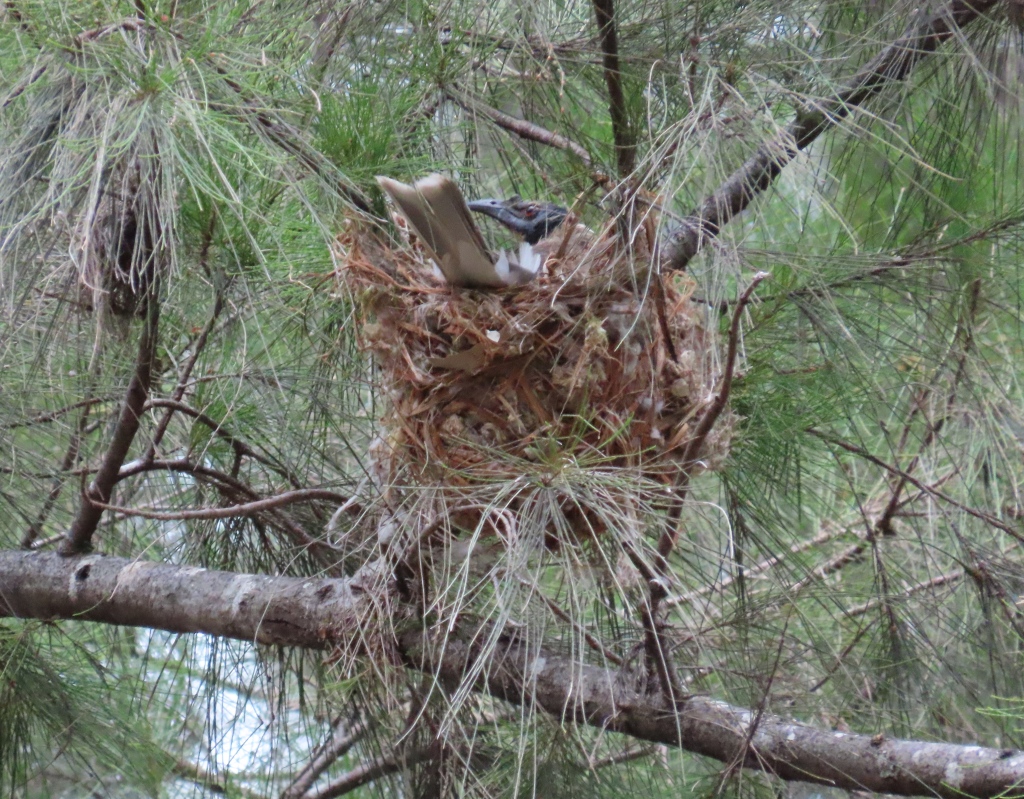
Noisy Friarbirds have a distinctive, slightly scary head: it’s bare of feathers, so that it looks a bit like a long black skull. Then there’s the large beak, with a knob on top. Not the prettiest of faces. The rest of the bird is quite pretty though, with creamy dappled white feathers below and soft browns and greys above, finished off with a white-tipped tail.
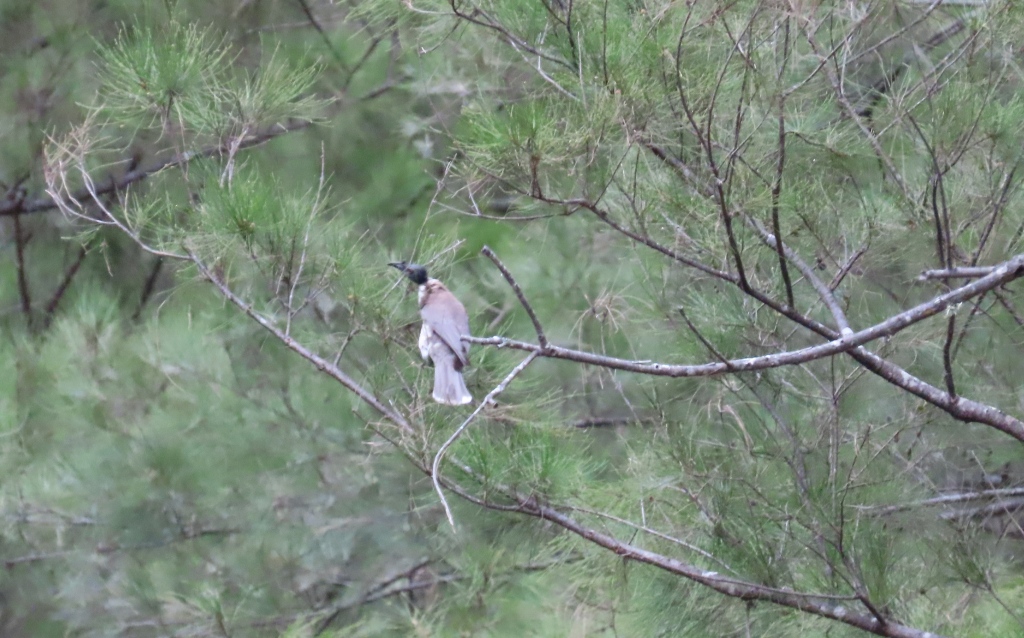
A few times, the birds would dive down steeply and fly horizontally just above the water. I think they were probably grabbing dragonflies and other insects as a tasty morsel:

This bird has something in its beak:

Common name: Noisy Friarbird
Scientific name: Philemon corniculatus
Approximate length: 30-35 cm
Date spotted: 23 December 2022 (summer)
Location: Coxs River Campground, Ganbenang, New South Wales, Australia: 33°44’35.1″S 150°10’45.1″E
Coxs River Campground is accessible only by four wheel drive. It’s a beautiful, restful spot, though it can get quite busy at times:


Channel-billed Cuckoo laying egg in Currawong nest
This little episode happened in my garden today. It was interesting and exciting to watch!
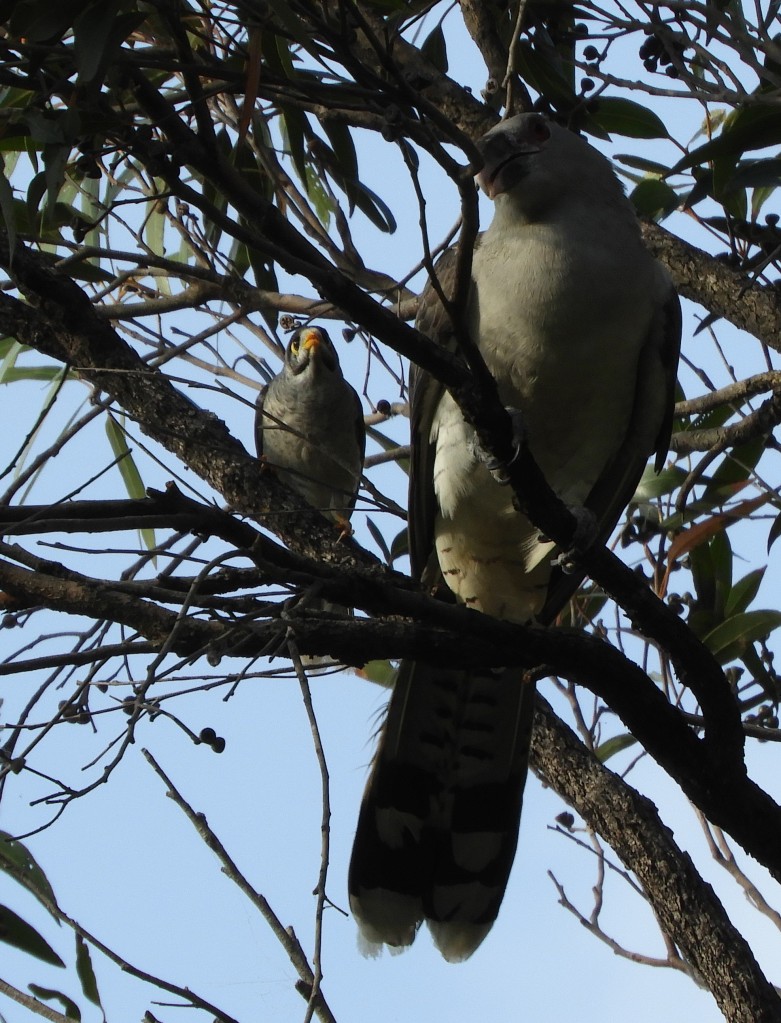
A cacophany of Noisy Miners and Currawongs drew me out into the garden to see what was up. High in a gum tree were two Channel-billed Cuckoos, being harassed as usual by the other birds. I only managed to get one of the cuckoos into my camera sights. Luckily, it turned out to be the female bird.
Here’s the Channel-billed Cuckoo on the right, with a little Noisy Miner by its side:
In this short video, you can hear the Noisy Miners peeping incessantly. The cuckoo emits a loud, harsh caw and cedes ground:
Next, the local Currawongs join the attack. The musical, bell-like tones are the Currawongs. The cuckoo flinches and utters its harsh croak. Then I noticed that there’s a Currawong nest just below where the cuckoo is sitting!
Like most cuckoos, Channel-billed Cuckoos are parasitic. They don’t build nests of their own. Instead, they look for a likely host (a Currawong does very nicely, thank you) and lay an egg in the chosen host’s nest. The Currawongs take over all parental duties, looking after the egg along with those of their own, then feeding the baby bird.
Channel-billed Cuckoo chicks don’t turf the other chicks out of the nest (many types of cuckoo chicks do) but they do eat a lot, and grow significantly bigger than the Currawong chicks.
Having decided that the neighbourhood is reasonably quiet and safe for a bit, the cuckoo eyes the nest and starts its approach:
Quick as a flash, it hops up into the nest and lays its egg:
Below is a still picture of the Currawong’s nest. I’ll keep an eye on it, in case I can spot the Currawong and cuckoo chicks when they arrive:

Channel-billed Cuckoo | Scythrops novaehollandiae | Approximate length: 58-65 cm
Noisy Miner, also called Australian Miner | Manorina melanocephala | Approximate length: 26 cm
Pied Currawong | Strepera graculina | Approximate length: 45 cm
Date spotted: 10 October 2021 (spring)
Location: Allambie Heights, New South Wales, Australia

So cute! Baby kookaburra in nest
For the past few weeks, I’ve been following the progress of a baby kookaburra and its parents. The baby was housed in a termite nest on an old, dead tree. The first time that I noticed the nest was more than a month ago, on 17 November. At that time, the only sign of the baby was a faint crooning sound emerging from the termite nest. I’d heard baby kookaburras before, so I stuck around to see what would happen. Sure enough, an adult bird arrived with some food.
From that day on, I visited the nest regularly. And now, I’m delighted to report that the baby bird has safely left the nest and is being fed in the nearby trees.
The first video shows the baby kookaburra just a few days before it left the nest. The date was 14 December, almost a full month after I first noticed the nest. In the video, the baby peers curiously (and hungrily, no doubt) from the nest. You can hear an adult kookaburra off camera, calling to let the chick know that food is on its way. I moved the camera to take in the adult on a nearby branch. The bird checks the surroundings carefully, including me, to decide whether it’s safe to approach and feed the chick.
Meanwhile, the chick becomes more vociferous and sticks its head further out of the nest, impatient at the delay. The adult moved to a different branch to give itself a direct line of flight. I managed to catch a view of the adult there too, before moving back to the nest in time to see the adult arrive and feed the baby:
The parents were tireless and devoted in their care for the baby. On a couple of occasions, I spotted them foraging for food:

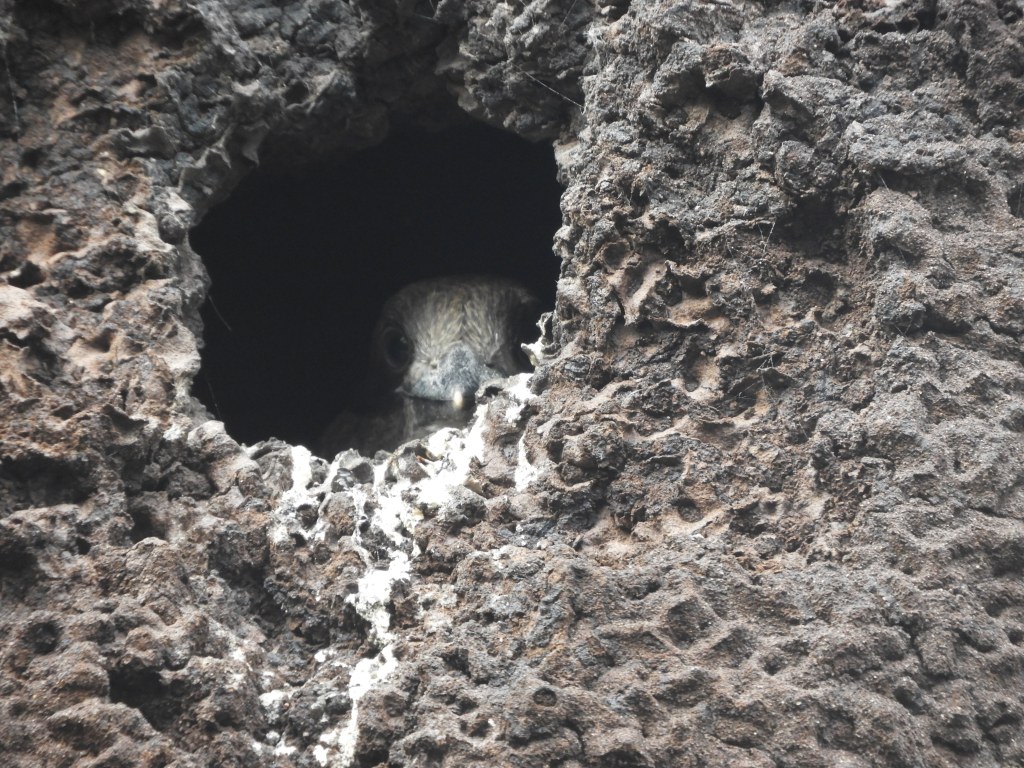
When the parents were not around, the chick eyed me from the safety of its home. The smallest scuffle was enough to bring an inquisitive eye to the hole in the nest:
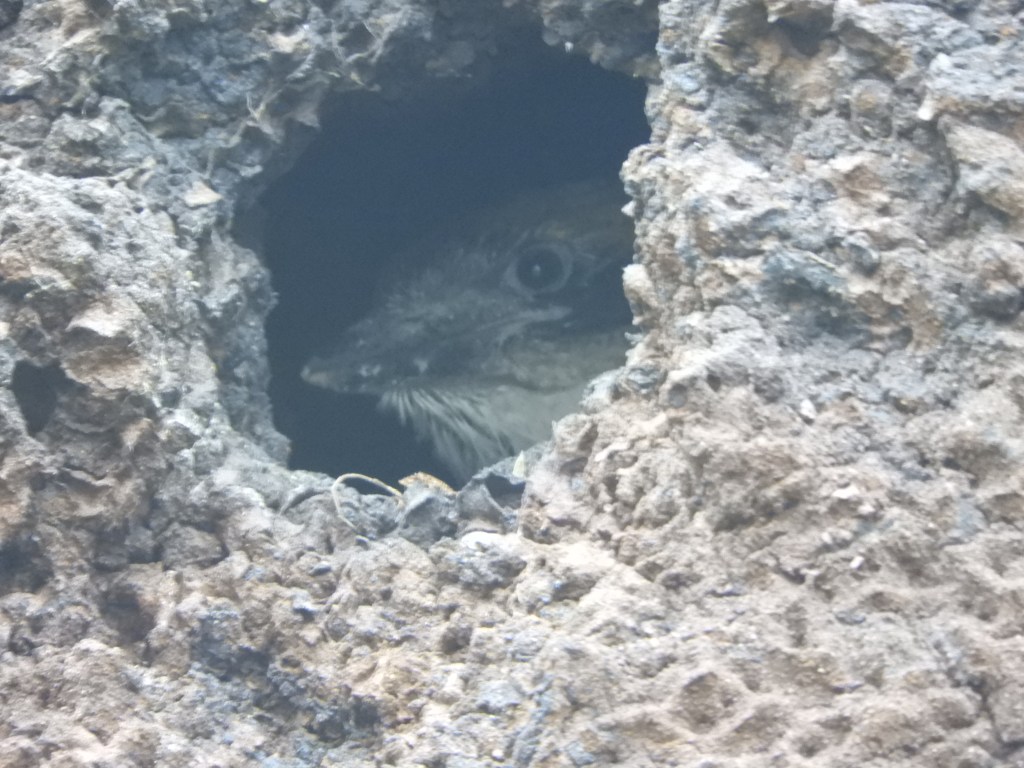
Partially hidden but oh so curious:
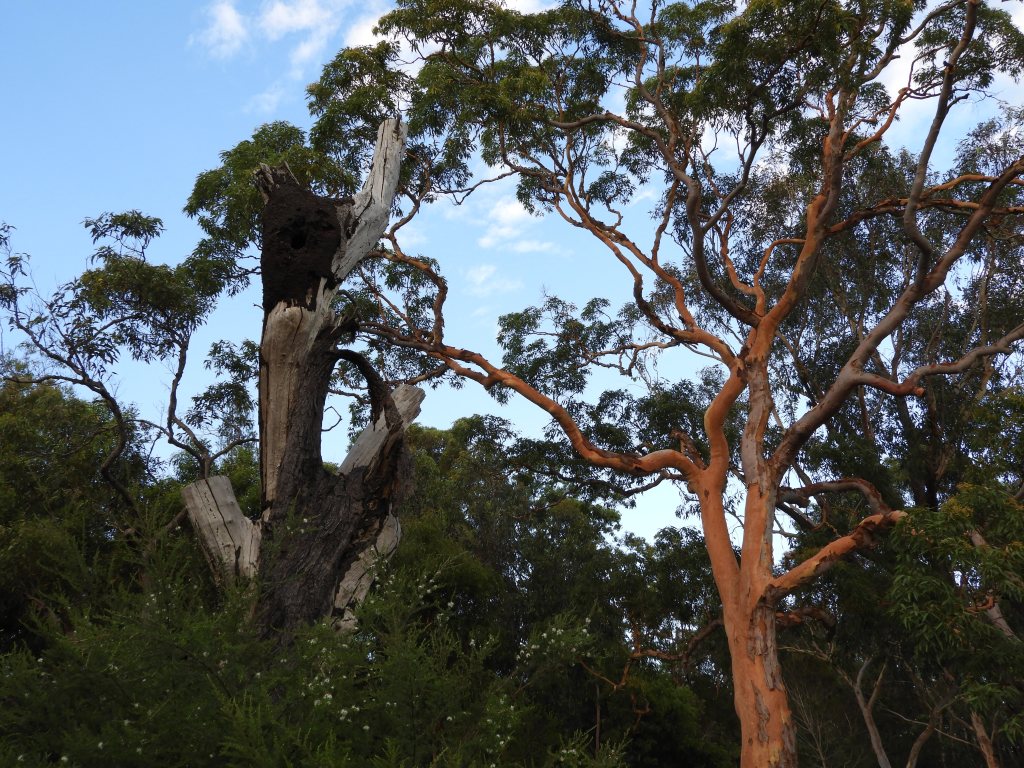
The nest was on the skeleton of a dead tree:
This is an earlier, short video (taken on 3 December) showing a parent arriving to feed the chick:
When I arrived on 17 December, the nest was quiet. Again the next day, there was no activity at the nest. I explored the area and soon heard the characteristic crooning of a kookaburra youngster. I found it in a quiet, tree-filled glen, being attended to two adults in turn. It was early in the morning, and the birds were high in the trees, so I didn’t manage to get a good photo. This is the glen:

This is the only photo I have of the youngster. Alas, I didn’t get the full head in the shot, but you can see the fluffiness of the feathers and the short tail:

Common name: Laughing Kookaburra
Scientific name: Dacelo novaeguineae
Approximate length: 47 cm
Date spotted: 18 December 2020 (summer)
Location: Manly Dam Park, New South Wales, Australia
This is the view the baby kookaburra had from its nest. It looks over Manly Dam towards the dam wall, with a bottlebrush bush glowing in the early morning light. A room with a view indeed:

Finally, here’s the view that the baby must have seen when it first emerged from its nest and could look in the other direction, up the length of Manly Dam:

Baby Noisy Miners doing well
Here’s an update on the nest of Australian Miners, also known as Noisy Miners, across the road from our house. The babies are getting bigger!
In this video, you see one of the chicks perched on the edge of the nest, making the incessant chirping that’s surely designed to drive a parent mad. One of the adults drops in with a quick morsel of food, and you can see both babies. I’m pretty sure there are only two chicks in the nest:
It’s quite a change since my previous post about the baby birds, just five days ago. This chick looks ready to take its first steps out of the nest:

Common name: Noisy Miner, also called Australian Miner
Scientific name: Manorina melanocephala
Approximate length: 26 cm
Date spotted: 30 March 2020 (late summer)
Location: Near Sydney, NSW, Australia
Australian Ravens building a nest and crooning
Nesting is a tricky business. If you’re an Australian Raven, there’s a lot of moaning involved. I heard the fuss while walking along a bush path, and peered up high into the trees to see what all the commotion was about. This video starts with the two ravens weaving twigs into their nest. The nest looks more like an untidy platform of sticks at this stage. The birds croon to each other throughout the process. One of the birds flies off. It lands close to me, grabs a stick, and makes a bit of a fuss about getting just the right grip before taking off for the nest:
Australian Ravens are large birds, with ice blue eyes, black plumage that shimmers blue in the sun, and a thick ruff of feathers under their beaks. When they’re flying, they make a long drawn-out cawing that can sound like a wailing cat.
The next video shows more of the nest building and crooning. At first one raven is alone in the nest, and takes time out to have a bit of a stretch. Then its partner arrives, and the serious business of nest building starts again. It’s funny how the birds’ voices wobble when they bob their heads up and down, trying to get those pesky sticks into the right position:
Common name: Australian Raven
Scientific name: Corvus coronoides
Approximate length: 50 cm
Date spotted: 24 August 2019 ( Late winter)
Location: Manly Dam Reserve, New South Wales, Australia: 33°46’59.7″S 151°15’14.8″E
Termite nest in tree
There’s no bird in this post, but something that birds encounter often: a termite nest high in a tree. This one is in Manly Dam National Park, near Sydney, Australia:

Termites that build nests in trees are called arboreal termites. They carry mud up the tree and use it to build their nests, which can grow rather large, like this one. I’ve come across tunnels of mud that run across roads and up trees. The termites build the tunnels for protection from the sun and from scavenging creatures. The termites usually also have underground tunnels.
Here’s a closer view of the same nest:

When the nests are old and abandoned, birds like kookaburras will dig holes in them and use them as homes.
Red Wattlebird nest may be in peril
My previous post introduced the nest that a pair of Red Wattlebirds have built in a tree fern in my garden. Things are looking a little perilous for the nest. The tree fern has put in a growth spurt, its new fronds lifting parts of the nest into an untidy jumble.
This is what the nest looked like yesterday. Notice the new, brown fern fronds unfurling in the midst of the grey matter that forms the birds’ nest:
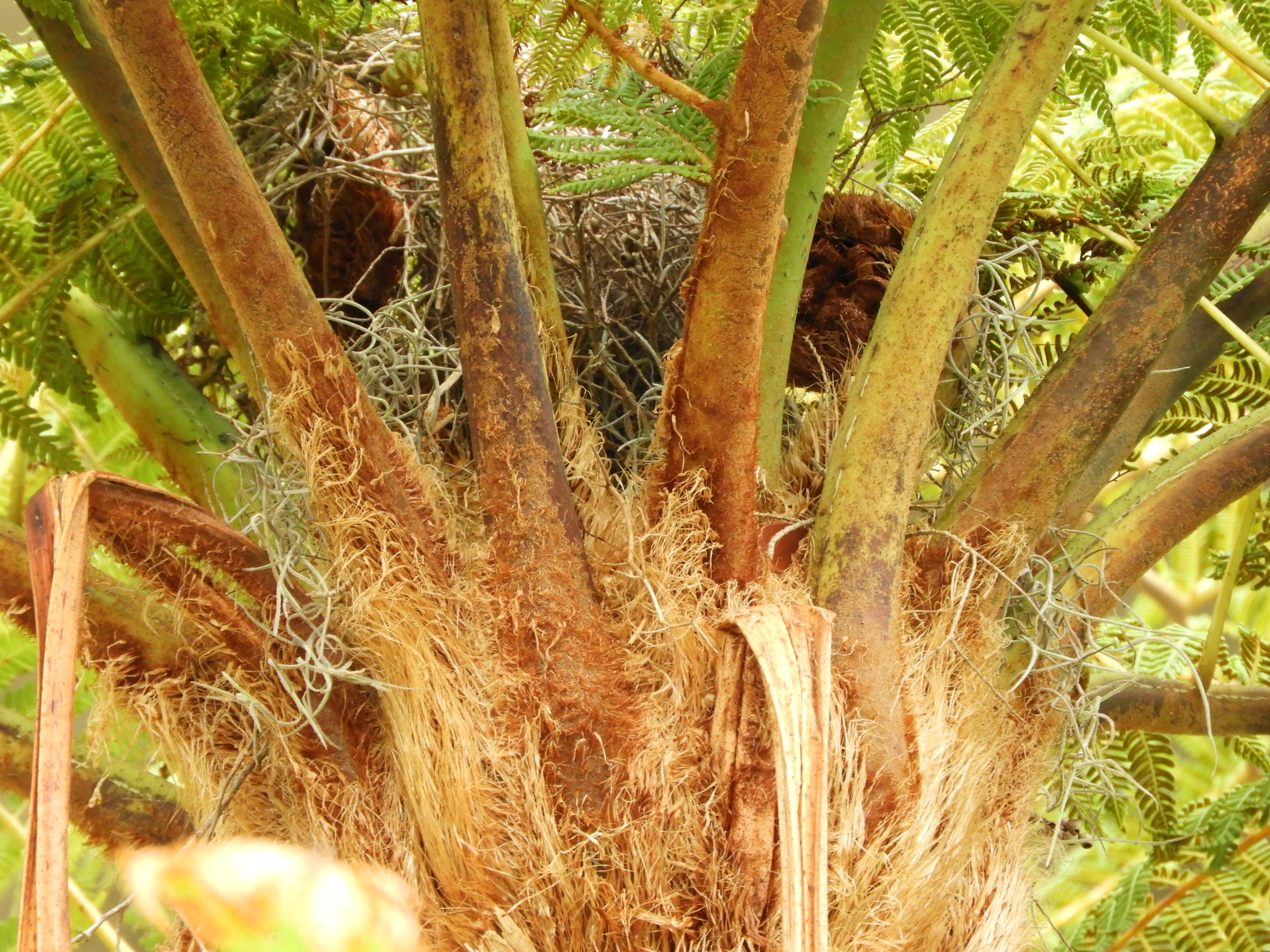
Compare that with the photo I took a week earlier, on 22 December, as shown in my previous post:

The parents still seem attentive. I’ve seen them flit in and out of the nest. Here’s one of them grabbing nourishment yesterday, from the nearby Banksia that seems to be their principle source of nourishment while nesting. The ghastly noise in the background is the cicados, who are out in full force this summer:
Birds are quite handy with their beaks and feet. I hope they manage to push the nest and eggs into a safe place as the fern tree grows.
Common name: Red Wattlebird
Scientific name: Anthochaera carunculata
Approximate length: 35 cm
Date spotted: 29 December 2017 (Summer)
Location: Allambie Heights, near Sydney, Australia


 Sydney Birder