Category Archives: Honeyeater
Red Wattlebird on Banksia
Red Wattlebirds are large, noisy honeyeaters. They get their name from the red flaps of skin below their eyes. This one was feeding on the nectar of a Heath Banksia flower:

The next picture shows both wattles on the bird’s neck:
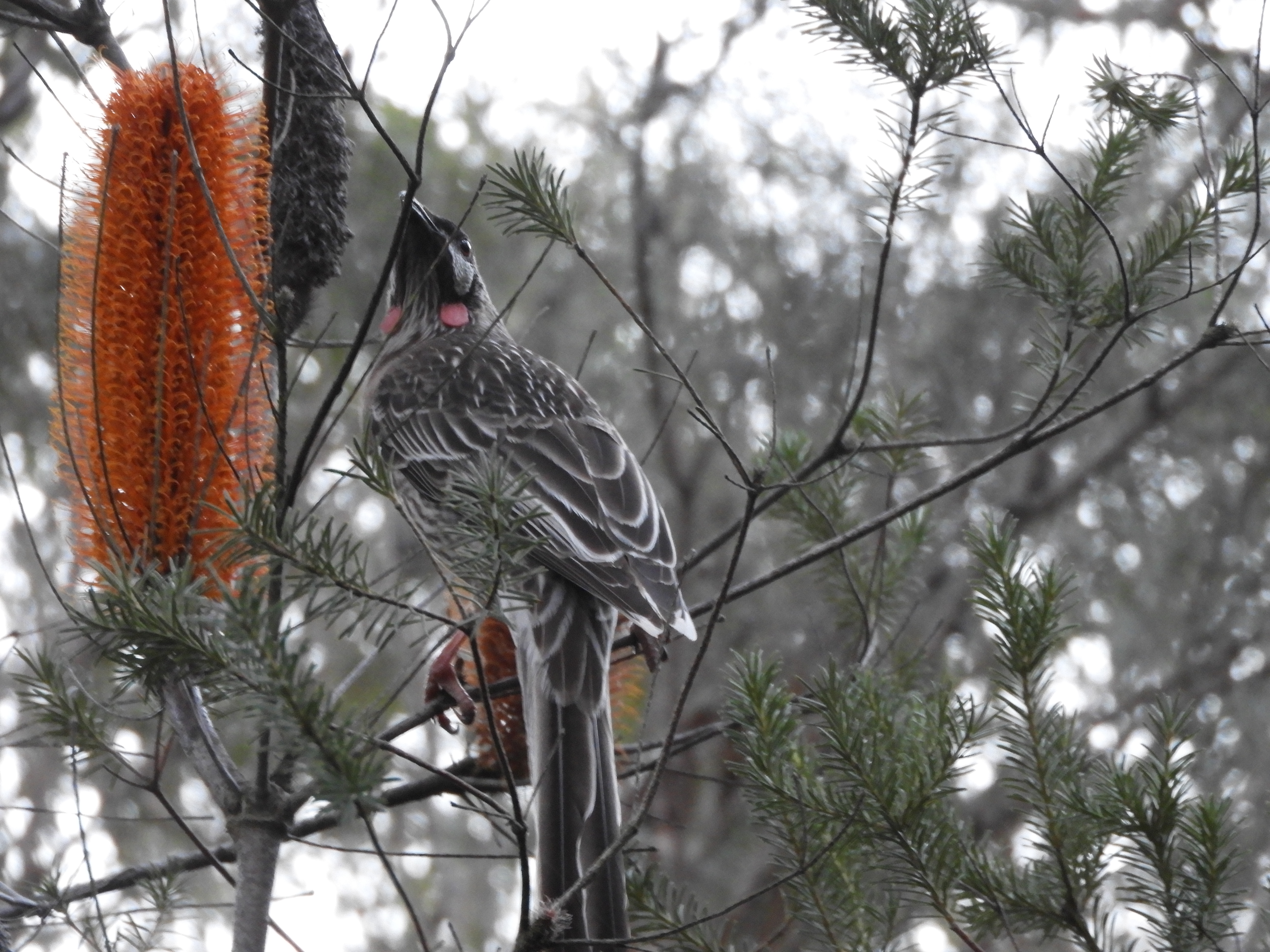
Common name: Red Wattlebird
Scientific name: Anthochaera carunculata
Approximate length: 35 cm
Date spotted: 18 July 2020 (winter)
Location: Manly Dam National Park, New South Wales, Australia. Approximate map reference: 33°46’27.0″S 151°14’57.6″E
Little Wattlebirds are common in the area too. The two birds can be hard to tell apart. Red Wattlebirds are larger (approx 35 cm from head to tail) whereas Little Wattlebirds measure approximately 30 cm. Little Wattlebirds don’t have the large red wattles. Here’s a Little Wattlebird that I photographed a while ago:

White-cheeked Honeyeaters and New Holland Honeyeaters hanging out together
Until today, I didn’t realise that we have two very similar types of honeyeaters in the area. I’ve seen and photographed New Holland Honeyeaters before. Yesterday, I took some photos of a number of birds, thinking they were all the same type.
Looking at the photos today, I noticed that some birds in the group have black eyes, some white, and the black-eyed birds seem shorter and more compact than the others. It turns out that the group included White-cheeked Honeyeaters, which I haven’t knowing seen before. They’ve probably been around all along, but I just didn’t notice.
This is a New Holland Honeyeater. Notice the white eye, and the smallish white patch near the beak:

Another New Holland Honeyeater:

Whereas the next one is a White-cheeked Honeyeater. Notice the black eye and the large white patch on the cheek:

This video shows a couple of White-cheeked Honeyeaters. You can hear the calls of the other birds around them:
While I was watching the group of birds, they would all hang out together in their chosen area of bushy cover, then emerge to go foraging in the nearby trees. Every now and then, something would alarm them, and they’d all dive for cover again. Standing near them was a little alarming, as they move extremely fast and I could hear them hitting the leaves all around. After a few moments, they’d emerge and repeat the pattern. The next video shows one such episode:
Common name: White-cheeked Honeyeaters and New Holland Honeyeaters
Scientific name: Phylidonyris nigra and Phylidonyris novaehollandiae
Approximate length: 16-19 cm and 17-19 cm
Date spotted: 9 November 2019 (spring)
Location: Manly Dam Reserve, New South Wales, Australia: 33°46’55.8″S 151°15’26.2″E
Yellow-tufted Honeyeater at Bobbin Head
A pair of Yellow-tufted Honeyeaters darted through the mangroves around the boardwalk at Bobbin Head. I managed to catch a snap of one of them before they both disappeared.
The photo shows the yellow tuft of feathers behind the black mask around the eye. The tuft is what gives the bird its name:

This bird is related to the Helmeted Honeyeater, a subspecies of Yellow-tufted Honeyeaters that is critically endangered and is found only in three small areas of Victoria.
Common name: Yellow-tufted Honeyeater
Scientific name: Lichenostomus cratitius
Approximate length: 16-19 cm
Date spotted: 28 August 2019 (late winter)
Location: Bobbin Head, Ku-ring-gai Chase National Park, New South Wales, Australia: 33°39’50.8″S 151°09’18.3″E
Ninja wattlebird – now you see it now you don’t
Spot the bird:

It’s a common sight to see a Little Wattlebird on a banksia flower, digging its beak between the florets to find the nectar. I hadn’t realised until now, though, how perfectly camouflaged the bird is on the grey branches of a mature banksia, particularly when surrounded by dead flowerheads.
Here’s a closeup pic of the bird, looking supremely confident though, dare I say it, not very well groomed:
These are the flowers of the Banksia Serrata tree where I saw the bird:
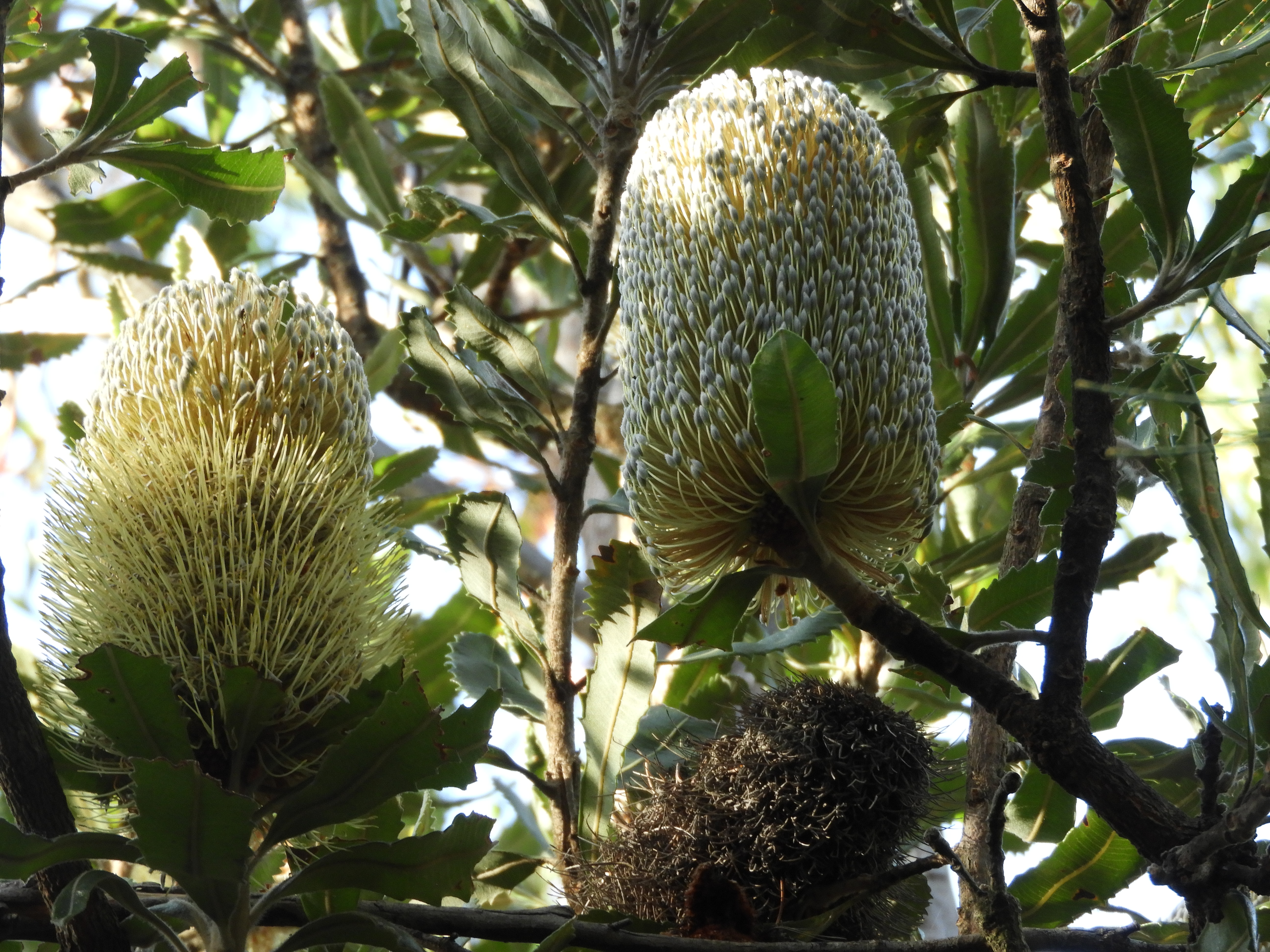
The wattlebird later moved to a bare branch to do a bit of grooming. Caught in dishevelled silhouette against the morning sun:

Common name: Little Wattlebird
Scientific name: Anthochaera chrysoptera
Approximate length: 30 cm
Date spotted: 26 December 2018 (Summer)
Location: Manly Dam National Park, New South Wales, Australia: 33°46’15.4″S 151°14’45.0″E
Red Wattlebird nesting in a tree fern
Red Wattlebirds are the second largest honeyeaters in Australia. They’re noisy, aggressive, and sleekly pretty. And now we have a couple nesting in our garden.
I’d noticed recently that a Red Wattlebird was more aggressive than usual. It started swooping at me when I was hanging up washing. At the best of times, hanging the washing is a precarious activity in my backyard. It involves a bit of rock climbing and a skilled balancing act. Add a fierce bird, and things get interesting.
A few days later, I noticed the bird land on a high branch, take a careful look around while trying to appear nonchalant, then duck quickly into the top cover of a tree fern. Interesting. So I got out my zoom lens to take a look.
The nest is in the right-most tree fern in this photo. I’ve put up my washing line on the left, for local colour:

(In case you’re wondering: the house up above belongs to the neighbours. Mine is below, not in the picture)
A closer view of the tree fern:

Even closer, you can see the nest with a bird’s tail pointing out to the right:

Occasionally the parents leave the nest unattended. I haven’t spotted any movement, so I think the eggs haven’t hatched yet:

The birds have picked up some of the Spanish Moss from our garden, and used it to decorate the nest. This is our supply, handily positioned just a few metres from the tree fern:

Sitting on a nest is demanding work. One of the parents emerged for a good stretch:

And a bit of grooming:

Then dived down to sip some nectar from a Banksia tree, which we’ve also positioned just a handy few metres from the fern tree. In this picture you can see the two red wattles below the beak that give the bird its name:
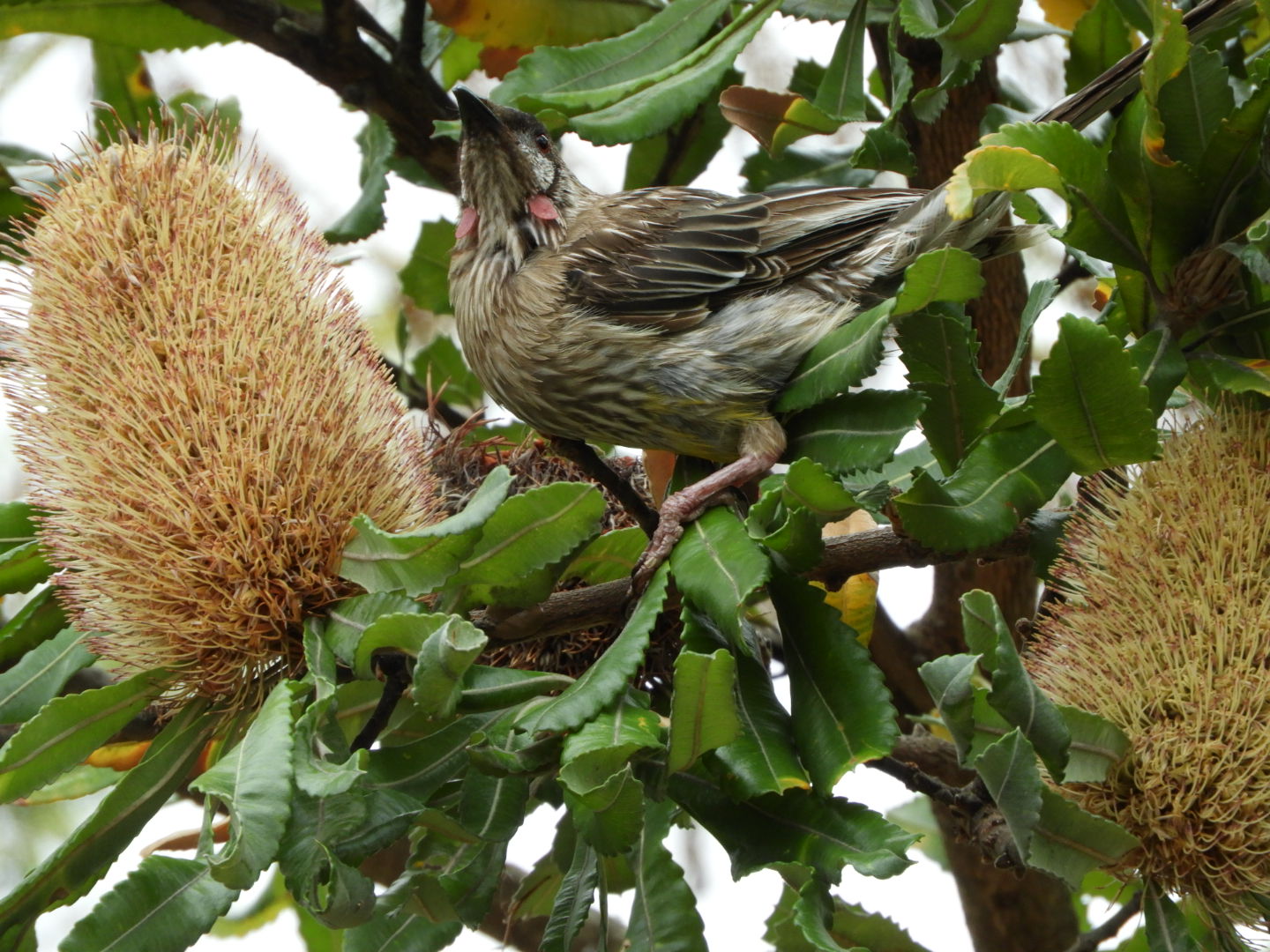
Here’s a picture of one of the local Red Wattlebirds on a nearby tree a few days earlier. It’s likely to be one of the nesting birds, though I don’t know for sure:

Common name: Red Wattlebird
Scientific name: Anthochaera carunculata
Approximate length: 35 cm
Date spotted: 22 December 2017 (Summer)
Location: Allambie Heights, near Sydney, Australia
New Holland Honeyeater enjoying a foretaste of spring
New Holland Honeyeaters are attractive in their neat black and white stripes, with yellow flares on their wings and tail feathers. This one darts from flower to flower, enjoying a foretaste of spring in the closing weeks of winter.
Common name: New Holland Honeyeater
Scientific name: Phylidonyris novaehollandiae
Approximate length: 17-19 cm
Date spotted: 22 August 2016
Season: Late winter
Location: Manly Dam Reserve, New South Wales, Australia
Approximate latitude/longitude: -33.772336, 151.249022
New Holland Honeyeater at Wineglass Bay Lookout
Not in Sydney this time, I was at Wineglass Bay Lookout in Tasmania when I saw a bush full of New Holland Honeyeaters. This video focuses on one of them, then draws back to show the gorgeous location it’s chosen for its foraging.
Here’s a still picture. Click on it to open it in a new window where you can zoom into the detail.

Common name: New Holland Honeyeater
Scientific name: Phylidonyris novaehollandiae
Approximate length: 17-19 cm
Date spotted: Sunday 9 November 2014
Season: Spring
Location: Wineglass Bay Lookout, Tasmania
Approximate latitude/longitude: 42°08’60.0″S 148°17’20.2″E
New Holland Honeyeater at Manly Dam
This pretty little bird is a New Holland Honeyeater, chirping happily amongst the spring flowers at Manly Dam Reserve.
Common name: New Holland Honeyeater
Scientific name: Phylidonyris novaehollandiae
Approximate length: 17-19 cm
Date spotted: Sunday 6 October 2013
Season: Spring
Location: Manly Dam Reserve, New South Wales, Australia
Approximate latitude/longitude: -33.77294,151.249416


 Sydney Birder