Category Archives: Honeyeater

White-cheeked Honeyeater enjoying the spring blossoms
A White-cheeked Honeyeater peeks out from a flower-covered bush. The bird is mostly black and white, but you can just make out some of the yellow markings on its wings and tail:
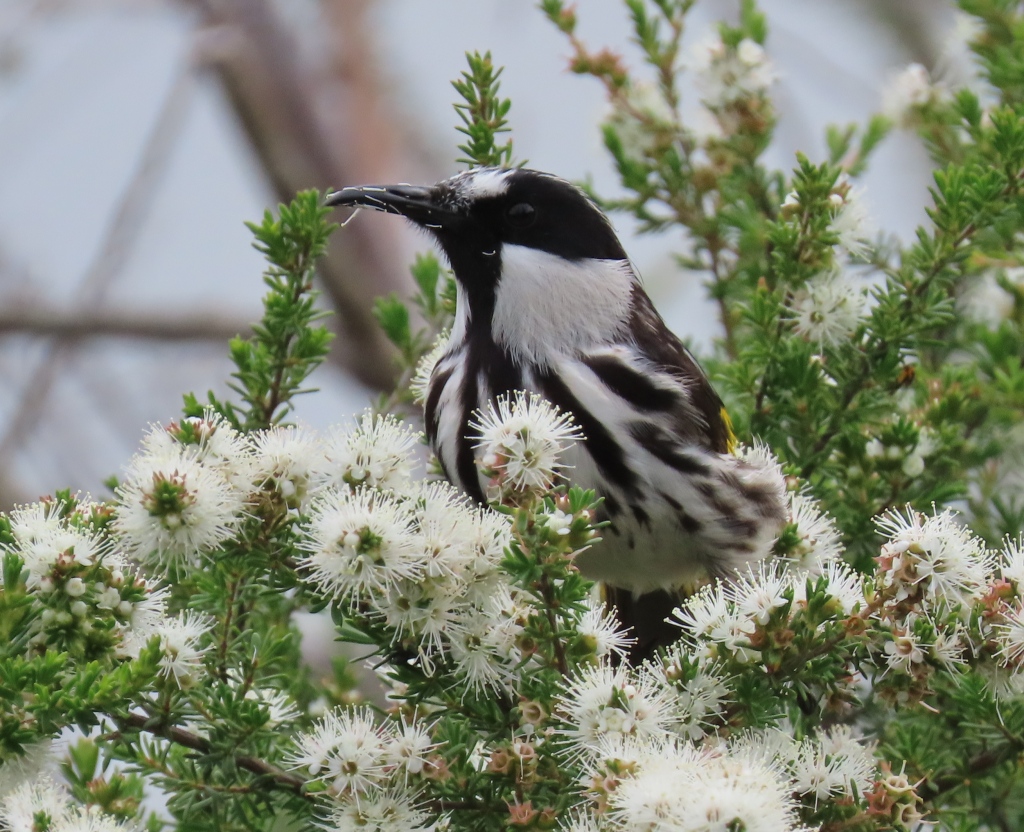
If you have trouble distinguishing these little birds from New Holland Honeyeaters, you’re not alone! This one has the black eye and large white cheek patch that identify it as a White-cheeked Honeyeater. A while ago, I took some photos of both birds to compare them.
Common name: White-cheeked Honeyeater
Scientific name: Phylidonyris nigra
Approximate length: 16-19 cm
Date spotted: 20 November 2023 (spring)
Location: Manly Dam Reserve, New South Wales, Australia: 33°46’30.3″S 151°14’46.6″E

Yellow-faced Honeyeater at entrance to Manly Dam
As I was walking through the gates at Manly Dam park, I heard this little Yellow-faced Honeyeater in the bushes at the roadside:
These birds move very fast, as you can tell from the video. It was only a few months ago that I saw my very first one. Now that I know what they are, I’ve seen a few of them. They have a distinctive yellow stripe running under the eye.
Here’s a still photo of the bird:

Common name: Yellow-faced Honeyeater
Scientific name: Lichenostomus chrisops
Approximate length: 16-18 cm
Date spotted: 10 July 2023 (winter)
Location: Manly Dam, New South Wales, Australia: 33°46’58.0″S 151°15’21.0″E

My first Lewin’s Honeyeater
Australia hosts several types of honeyeater, and I’ve spotted a few of them over the lifetime of this blog. Recently I saw my very first Lewin’s Honeyeater:
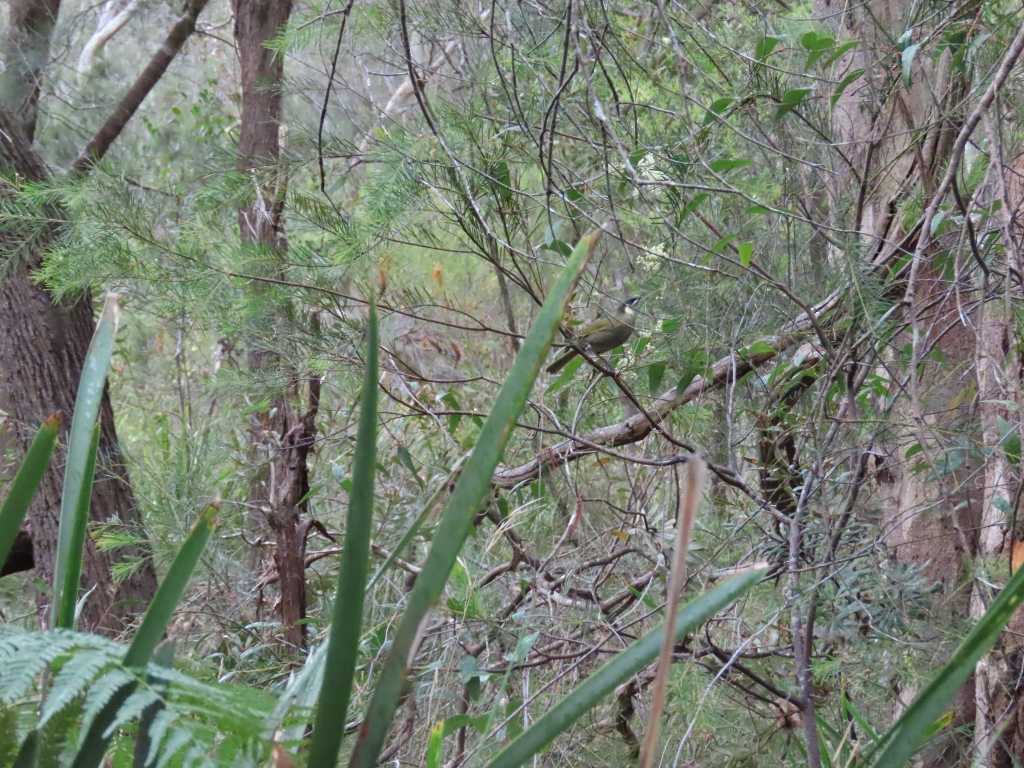
Lewin’s Honeyeater is a medium-sized bird. As is the case with other honeyeaters, nectar forms a major part of their diet. They also eat fruits and insects. They have a distinctive, crescent-shaped yellow ear patch as well as a light yellow stripe under each eye.
According to my bird book, they’re “abundant”, especially in the wetter areas of eucalypt forests. I’ll keep a look out now that I know they’re around.
Common name: Lewin’s Honeyeater
Scientific name: Meliphaga lewinii
Approximate length: 19-22 cm
Date spotted: 5 June, 2023 (winter)
Location: Manly Dam Reserve, New South Wales, Australia: 33°46’47.6″S 151°14’53.2″E

Two more Yellow-faced Honeyeaters!
A few weeks back, I saw my first ever Yellow-faced Honeyeater (recorded in this blog post). At that time, I was near the little town of Capertee, out west of Sydney. Since then, to my surprise, I’ve spotted two of them at my frequent haunt: Manly Dam on Sydney’s Northern Beaches.
The first occasion was when I was filming an Eastern Spinebill that was dipping itself into a quiet pool in the creek that feeds Manly Dam. Towards the end of the video, another bird flutters into view. It’s a Yellow-faced Honeyeater:
A couple of weeks later, I saw another Yellow-faced Honeyeater, this time in the forest on the southern shore of the dam (33°46’50.5″S 151°14’54.1″E):
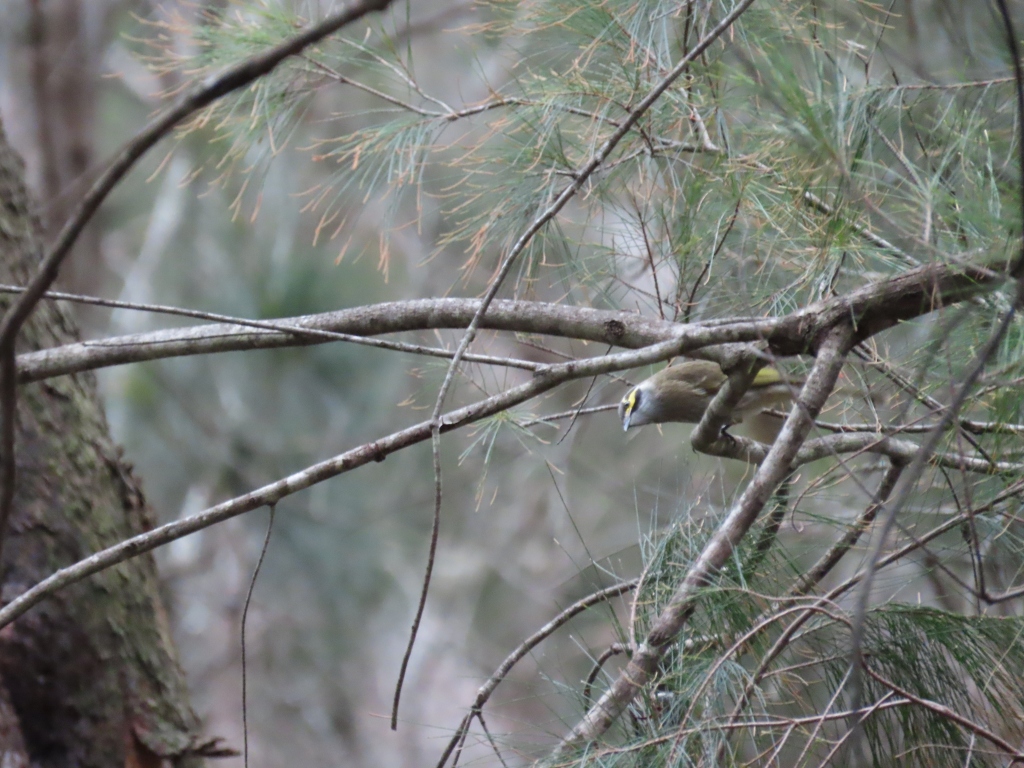
Common name: Yellow-faced Honeyeater
Scientific name: Lichenostomus chrisops
Approximate length: 16-18 cm
Date spotted: 14th and 26th May 2023 (autumn)
Location: Manly Dam, New South Wales, Australia: 33°46’50.5″S 151°14’54.1″E

Yellow-faced Honeyeater near Capertee
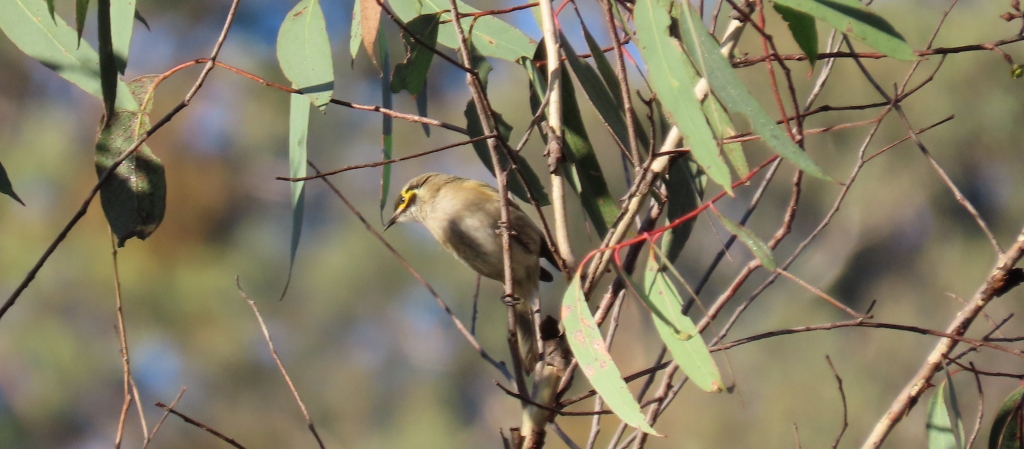
Yet another first sighting for me: a Yellow-faced Honeyeater that I spotted during last week’s trip out west of Sydney. I was taking an early-morning walk in the countryside near the little town of Capertee. It’s gorgeous out there. Rolling hills, vistas of the Blue Mountains, Eucalypt forests, and green grassy clearings.
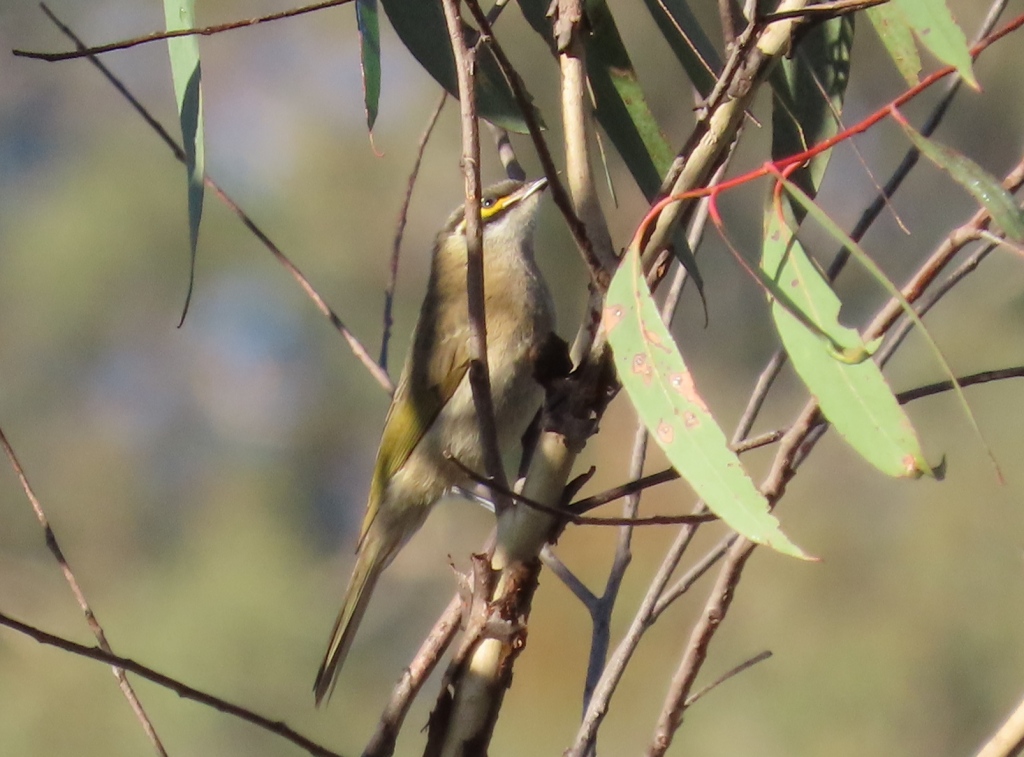
Yellow-faced Honeyeaters feed on manna, nectar, and small insects. They get their name from the yellow streak that runs across the face below the eye. The streak is bordered in black. Other colours on the bird range from off-white to grey-brown, with olive-yellow edges on the wings.
Common name: Yellow-faced Honeyeater
Scientific name: Lichenostomus chrisops
Approximate length: 16-18 cm
Date spotted: 23 April 2023 (autumn)
Location: Long Ridge, Capertee, New South Wales, Australia: 33°09’53.9″S 150°00’06.2″E

Soft colours of a young Little Wattlebird
This bird was busy gathering food on an Old Man Banksia tree (Banksia serrata). It has a small insect in its beak:

I think the bird is a Little Wattlebird, though others that I’ve seen have been darker and greyer in colour. Perhaps it’s a juvenile. I considered an oriole, but the stripes on this bird’s chest are more like those of a wattlebird than an oriole, and the shapes of the beak and head are closer to those of a wattlebird too.

Little Wattlebirds don’t have the red wattles that give this genus its name. These birds are classified as honeyeaters, but like most honeyeaters they’ll grab a passing insect too. This bird was at Dobroyd Head, one of the pieces of land that jut into Sydney Harbour.
Here’s a view that shows more of the wings and back:

Common name: Little Wattlebird
Scientific name: Anthochaera chrysoptera
Approximate length: 30 cm
Date spotted: 11 March 2023 (autumn)
Location: Dobroyd Head Track, Balgowlah, New South Wales, Australia: 33°48’33.2″S 151°16’14.1″E

Scarlet Honeyeater at Dobroyd Head
A little Scarlet Honeyeater adds a dash of colour to a wintry day:
It’s interesting that the bird was focusing on the Red Spider Flowers (Grevillea). Perhaps it’s not a crazy idea to be bright red in colour if you spend your time among red flowers! I’ve read that these birds also frequent Bottlebrush shrubs (Callistemon) which are also red.
This is only my second sighting of a Scarlet Honeyeater. They’re small and move fast, which makes it hard to get a good shot. Here’s still photo of the same bird, a male:
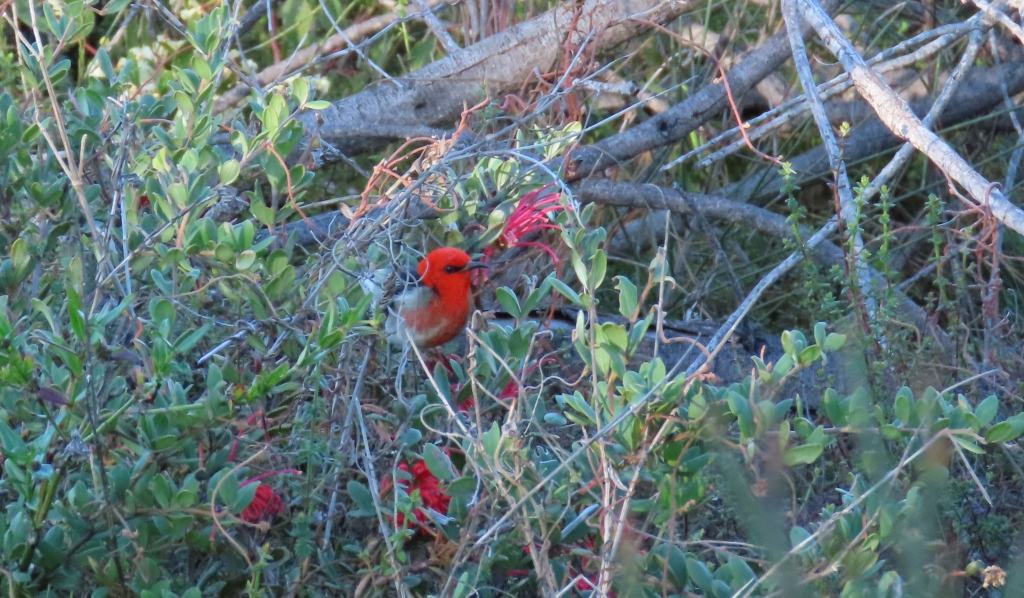
Scarlet Honeyeaters feed mainly on the nectar from flowers, hence their name. Sometimes they catch insects.
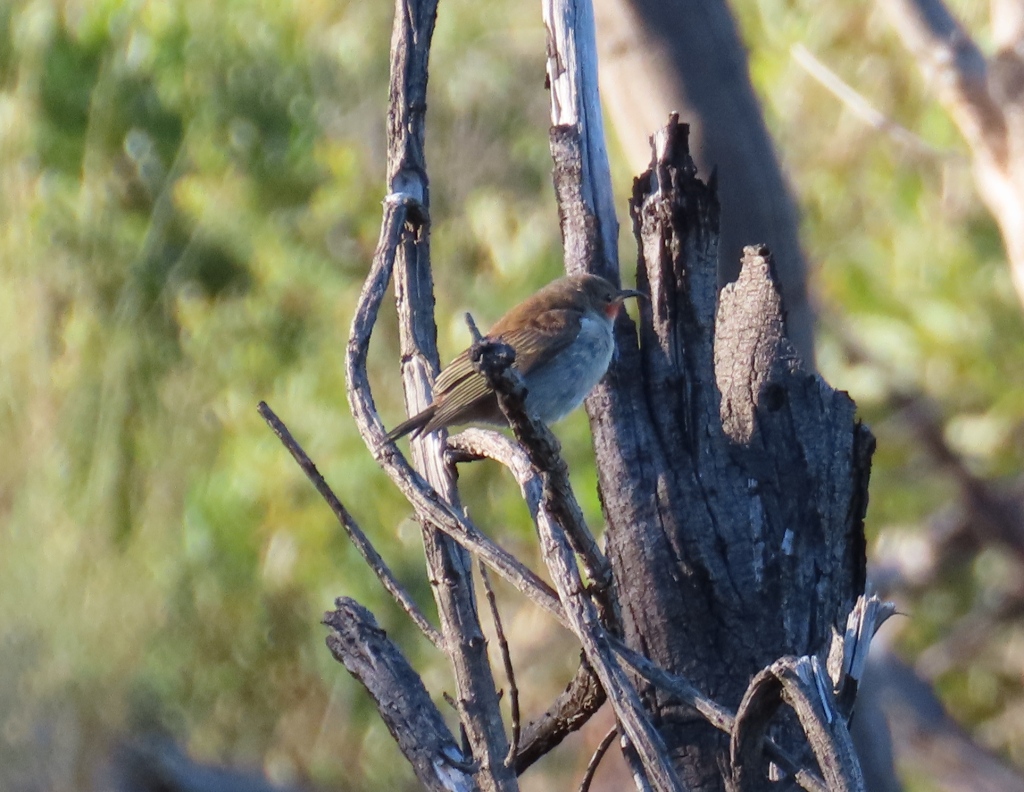
A female was close by. This photo shows the bird’s curved beak, a good tool for probing blossoms in search of nectar:
Common name: Scarlet Honeyeater
Scientific name: Myzomela sanguinolenta
Approximate length: 10 cm
Date spotted: 17 July 2022 (winter)
Location: Dobroyd Head, New South Wales, Australia: 33°48’36.4″S 151°16’19.0″E

A honeyeater and a view from Dobroyd Head
Dobroyd Head is one of the headlands that juts out into Sydney Harbour, on Australia’s east coast. The walking track leading around Dobroyd Head is part of the Manly to Spit Bridge Trail. It offers plenty of bird life and gorgeous views.
When taking this picture, I was at Fairlight Lookout on Dobroyd Head, looking north east across the harbour towards Manly. On the other side of Manly is the Pacific Ocean. Next stop Fiji and then the United States.

This pretty little bird is a New Holland Honeyeater, its white ear patch tousled by the breeze:

Common name: New Holland Honeyeater
Scientific name: Phylidonyris novaehollandiae
Approximate length: 17-19 cm
Date spotted: 28 August 2021 (winter)
Location: Dobroyd Head, New South Wales, Australia: 33°48’34.7″S 151°16’18.2″E

Shy Eastern Spinebill
Eastern Spinebills have long curved beaks, giving rise to the name “spinebill”. They’re one of many types of Australian birds that live on plant nectar and insects. Unlike many other honeyeaters, though, spinebills are shy and don’t stay in one place for long.

The bird’s dramatic colours of white, black, and chestnut, as well as its red eye make it a striking presence in the Australian bush.
Common name: Eastern Spinebill
Scientific name: Acanthorhynchus tenuirostris
Approximate length: 16cm
Date spotted: 29 May 2021 (late autumn)
Location: Manly Dam Park, New South Wales, Australia: 33°46’29.7″S 151°14’46.0″E

My first Scarlet Honeyeater
Flashes of scarlet against the orange of a Banksia bloom first drew my attention to this tiny bird. It moved fast, never staying still for long. I managed to snap a couple of photos, though none very clear alas. I think it’s a Scarlet Honeyeater:

What a pretty little thing! I’ve been back to the same area a couple of times but not seen the bird again. Here’s another photo of the same bird after it moved to a different tree:

Common name: Scarlet Honeyeater
Scientific name: Myzomela sanguinolenta
Approximate length: 10 cm
Date spotted: 18 May 2021 (autumn)
Location: Manly Dam Park, New South Wales, Australia: 33°46’54.2″S 151°15’08.2″E


 Sydney Birder