Slime mound, yellow and webby
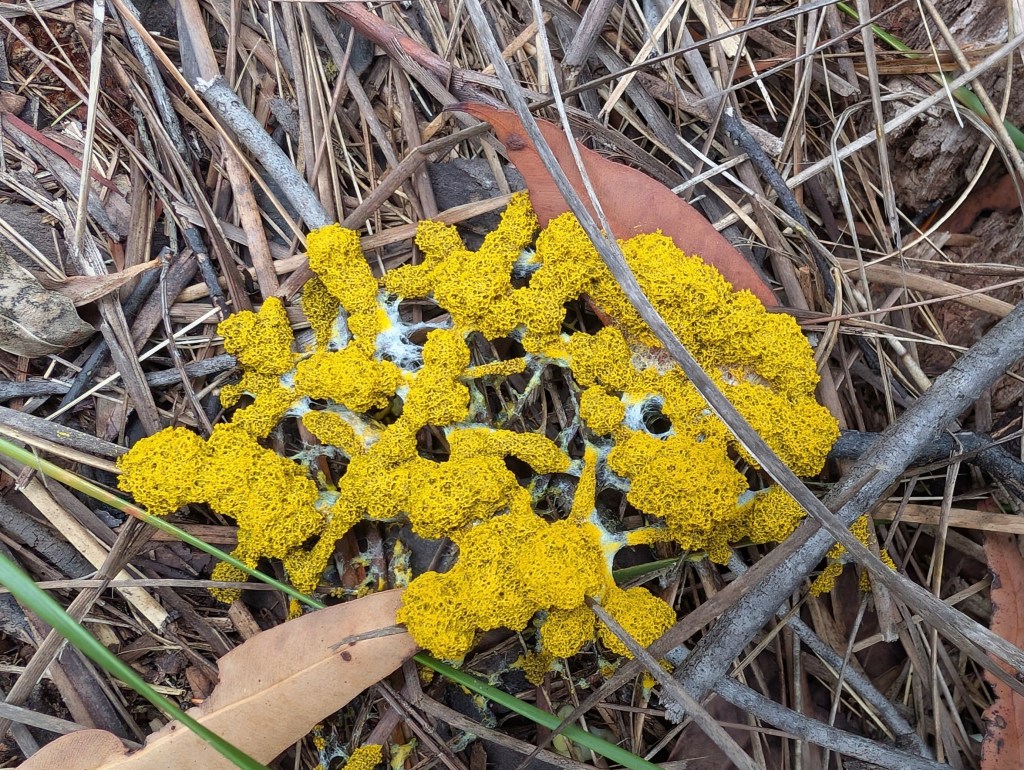
This morning I came across this interesting blobby set of yellow gunge. It’s a slime mould, specifically a dog vomit slime mould (Fuligo septica). And it’s out on its travels around Manly Dam park.
Slime mould, despite its name, is not a mould. It’s not a fungus at all, nor is it a plant. It’s actually a rather weird single-celled organism that can move around when it needs to find a better place to live. And it does that fairly often.
When the slime mould is in a food-rich area, it spreads out into a large blob called a plasmodium, to absorb as much nutrient as possible. Then it gathers itself together to produce spores and so make more little slime moulds.
Slime moulds can seem quite intelligent, if you examine their life style under the assumption that the most important things in life are food and reproduction. (And who’s to say that’s not so?) Slime moulds can remember where they last got a good feed and can find their way through complex mazes to get where they need to be.
So, led on by stories of super-intelligence, when I saw this slime mould spread across that white webby stuff, I thought it had formed itself around spider webs on the ground. There’s even a neat round web-lined hole at middle right which looks like something an Australian spider would love. I wondered whether the slime mould might gain some advantage from forming around spider webs, or whether it just got distracted by the web’s pattern?
Actually, the white webbing is part of the slime mould itself, not a spider web. The white stuff is a base layer called the hypothallus, left behind as the slime mould gathers together from its spreading, feeding stage (the plasmodium) to form the dense yellow mounds shown in the photo.
This is a bird blog, so where’s the bird? There’s no bird in this post, but evidently birds do eat slime mould. Mostly the birds eat the slime mould and various fungi by accident, when picking bugs out of tree bark. But Yellow-Tailed Black Cockatoos have been observed picking off pieces of bark and then scraping slime mould and fungi off the back of the bark.
If you’re interested in more stories from the world of fungi and the like, take a look at my Soothing Musing, The humble mushroom:

Posted on 2026/11/24, in Not a bird and tagged fungus, slime mould. Bookmark the permalink. Leave a comment.


Leave a comment
Comments 0