Monthly Archives: January 2020
Young Channel-billed Cuckoo fed by a currawong
A plaintive caterwauling drew my attention to the treetops this morning. A large bird sat high in a tree, calling and flapping its wings. It was a juvenile Channel-billed Cuckoo, waiting to be fed. As I watched, the adoptive parent arrived: a currawong. The currawong stuffed some food down the baby’s throat:
The baby cuckoo is already larger than its adoptive parent. Channel-billed Cuckoos are very large birds. In fact, they’re the largest of all parasitic birds. The body of the adult is more than half a metre long, and the wingspan is almost a metre. As the term parasitic implies, the cuckoo parents lay their eggs in the nests of other birds—in this case, a currawong’s nest—and the hapless host then raises the cuckoo chick.
In the next video, the young cuckoo is more restful, which gives you a chance to see its colouring. The very young birds have yellowish and brown colouring, whereas adults are light grey and dark grey. This youngster is close to adult colouring, but you can still see yellow here and there. The chirping noise that you hear throughout is the cicada beetles that rule the bush at this time of year.
Near the start of the video, the bird takes a sudden dislike to a dead twig nearby. Who knows why. Perhaps the bird is bored. Then a Noisy Miner arrives to alleviate the boredom. Noisy Miners, also known as Australian Miners, are noisy, as you may have guessed. They broadcast an alert whenever anything unusual appears in their territory. The young cuckoo reacts with alarm. In the nick of time, the host currawong arrives with another tasty treat.
I noticed that the currawong retreats hastily after delivering each morsel of food, and the cuckoo gives chase. I’d probably retreat too if my baby were that size!
Here’s a still photo of the young cuckoo. It’s eyes have not yet reached the dramatic red of the adult Channel-billed Cuckoo:

Bits of yellow and brown are still visible in the feathers, but this young ‘un has nearly attained the grey colouring of the adult.

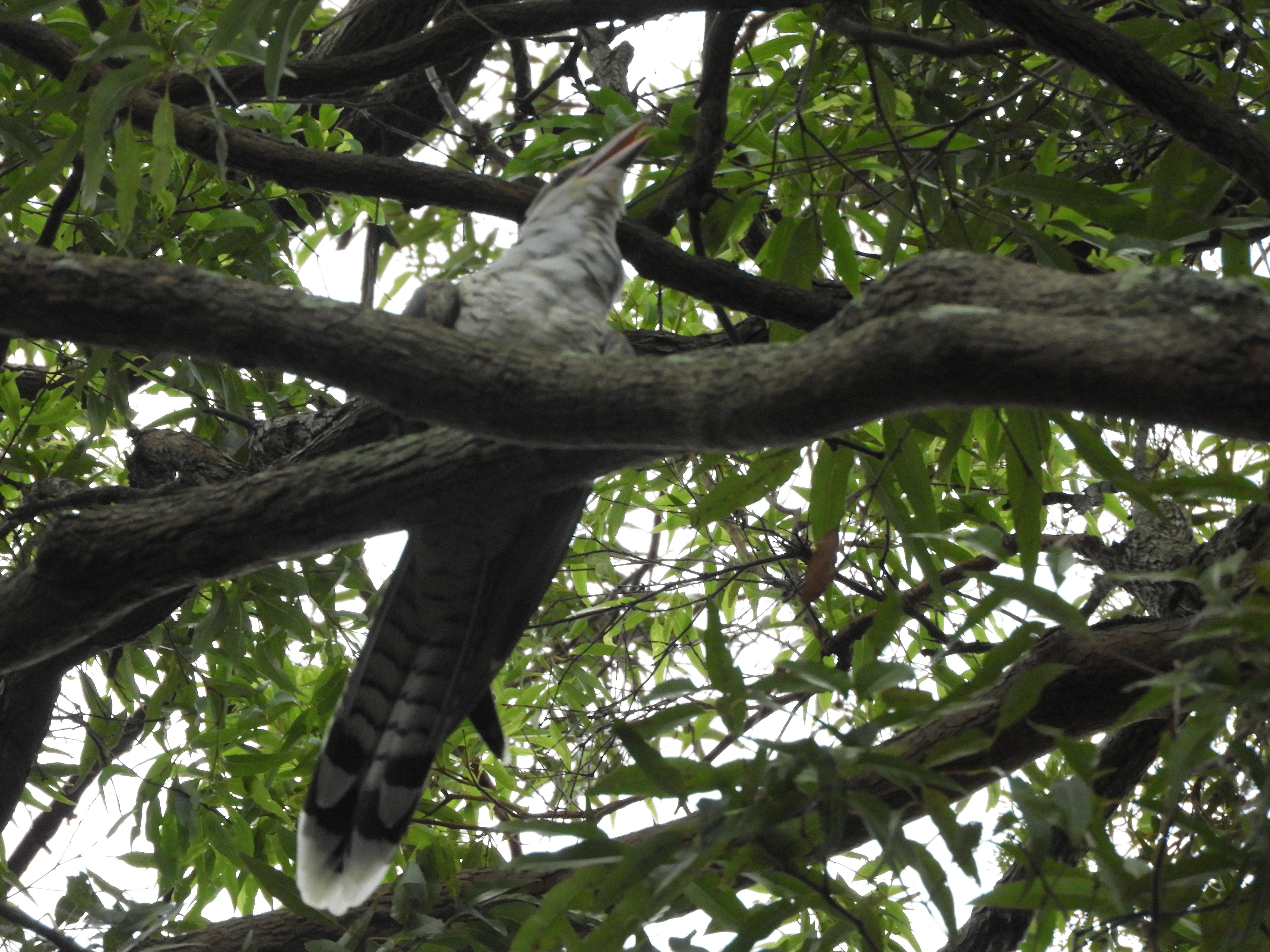
The next photo gives a good view of the youngster’s tail, which looks to be fully developed. I saw the bird flying from tree to tree, and it did a very good job of it. It will need its flying skills in a few weeks’ time, as these cuckoos are migratory. They come down the eastern coast of Australia in spring, around September, then fly back up north to Indonesia and other islands around March.
To see more pics and videos of these cuckoos, and to hear the horrendous noise the adults make, check out my list of cuckoo posts.
Common name: Channel-billed Cuckoo
Scientific name: Scythrops novaehollandiae
Approximate length: 58-65 cm
Date spotted: 25 January 2020 (summer)
Location: Manly Dam Reserve, New South Wales, Australia: 33°46’59.6″S 151°15’15.5″E
Australian Magpie singing
This young Australian Magpie dropped in to sing me a song! I think it’s a juvenile, as its eyes are brownish rather than red. It may be a female, as males tend to have a clearer demarcation between the black and the white sections of feathers, whereas females have more grey. But the colouring could be due to the bird being a juvenile.
The magpie spent at least ten minutes minutes singing, maybe more. I had time to grab my camera, make my way into the garden, film a few minutes from far away, then walk up and sit down near the bird and film again. This video is the result of the second set of filming.
Cool fact: Evidently magpies can hear the sounds of grubs and worms moving underground.
Common name: Australian Magpie
Scientific name: Gymnorhina tibicen
Approximate length: 40 cm
Date spotted: 6 January 2020 (summer)
Location: Near Sydney, Australia
St Andrew’s Cross spider – X marks the spot
This gorgeous spider created its web in a bush in my garden. I nearly stuck my nose into it when reaching to pull out a weed! It’s a female St Andrew’s Cross spider:

We see these spiders quite often. They always spin thick twirls radiating out from the centre of the web, usually four as this one has done. The spider arranges itself carefully so that its body and legs complete the pattern. X marks the spot where the spider lurks!
It’s not a four-legged spider! It’s arranged its legs in pairs. As you can see in this photo. the female has silvery squiggles on its thorax, and stripes of yellow, silver and black on its abdomen, with some polka dots thrown in for good measure. The male spiders are smaller and less colorful, primarily light brown and beige.
St Andrew’s Cross spiders aren’t dangerous to humans. They’ll try their best not to bite you, and their venom doesn’t do too much harm. I’m glad, though, that I didn’t actually bump it with my nose!


 Sydney Birder