Blog Archives

Python has just swallowed a meal
A few days ago, I saw this Diamond Python on Manly North Head near Sydney. The snake has recently had a meal, hence the thickening in part of the body. I’ve drawn a rough outline in a copy of the picture, so that you can see the shape of the snake more clearly.


The snake’s head is resting on its body near the middle of the picture. The snake lies mostly straight, with just one bend at the bottom of the picture. It’s well camouflaged, even though it’s lying out in the open to bask in the sun and digest its meal.
Diamond Pythons are just one of several types of pythons found in Australia, and are native to south eastern New South Wales. They’re large snakes, growing up to three metres long. They aren’t venomous, though they do have teeth and can bite. They lie in wait for their prey, and kill it by squeezing it to death. They eat the animal whole, then digest it once it’s inside their stomach. That’s what’s made the large bulge in this particular snake.
If you’d like to hear the story of another of these snakes, take a look at a Diamond Python in a Banksia tree.

Another gorgeous Red-bellied Black Snake
This was my third encounter with a Red-bellied Black Snake in three months! And that after never seeing one before.
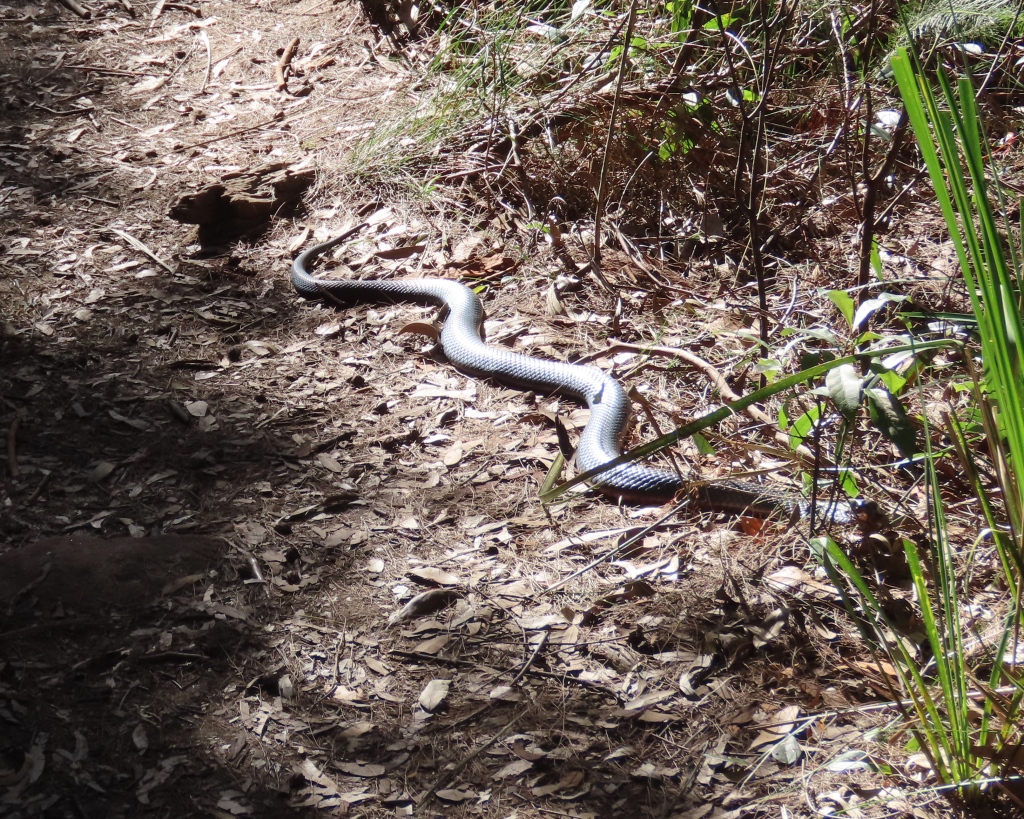
The snake was lying in the sun on the side of the walking track. I stopped to wait for it to move away. It was a big snake!
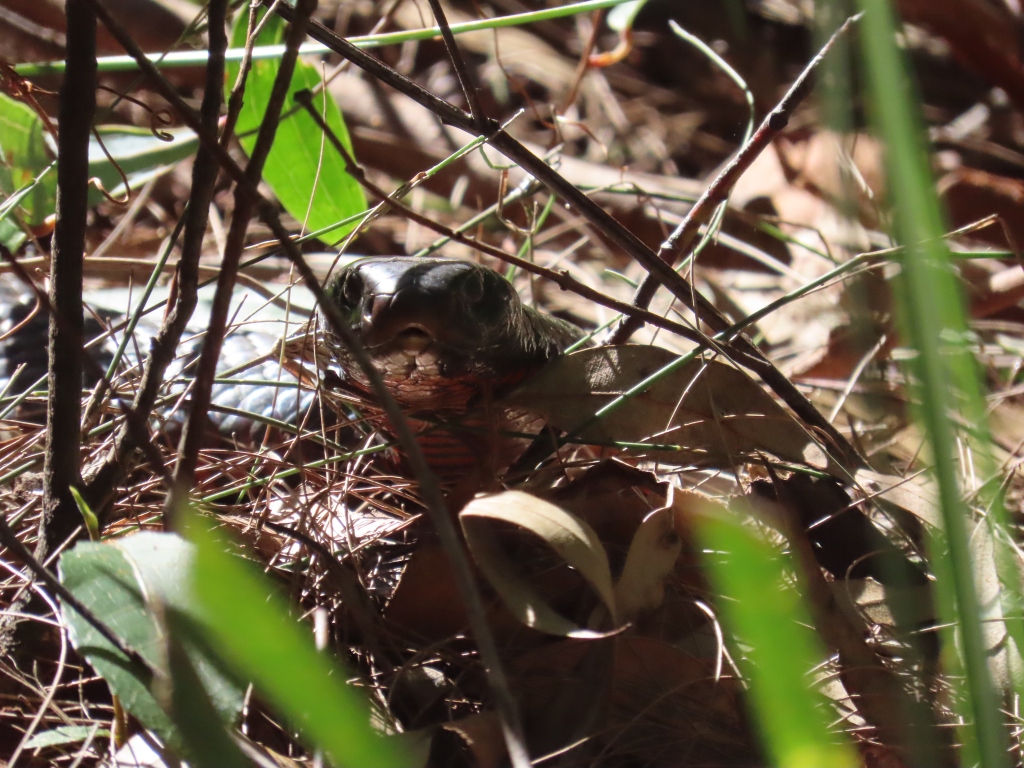
Red-bellied Black Snakes (Pseudechis porphyriacus) are quite large in comparison with other snakes I’ve seen. They’re a dark, shiny black on top, with a glowing red tinge underneath. You can see a bit of the red under-belly in this close-up of the snake’s head:
This snake was at Manly Dam (location on the map) where I often walk. My first encounter with a red belly happened near the Turon River, quite a way from my usual haunts. I posted a photo and video of that snake in another blog post. My second encounter was just a couple of weeks ago, a few hundred metres away from today’s snake at Manly Dam. It might have been the same snake.
Evidently the venom of Red-bellied Black Snakes isn’t as harmful to humans as some of the other snakes in these parts, but it can still make you quite ill. So it’s a good thing to give the snake its space. This one just watched me carefully. When I moved back, it slowly crossed the path in front of me and took shelter in the undergrowth. As I passed, I could see its head and flickering tongue as it watched me go.

Diamond Python in Banksia tree
A couple of days ago, when walking along a bush bath in the Manly Dam park, I met a man carrying an empty cloth bag attached to a stick. I said hallo, received a friendly greeting in return, then asked him what he was capturing. He said, “Releasing, not capturing.”
“OK, what are you releasing?” said I.
“A Diamond Python.” When I responded with a delighted smile rather than a fearful gasp, he said, “Would you like to see it?” He led me down a path and pointed to the snake, which was making its way happily up a Heath Banksia tree.
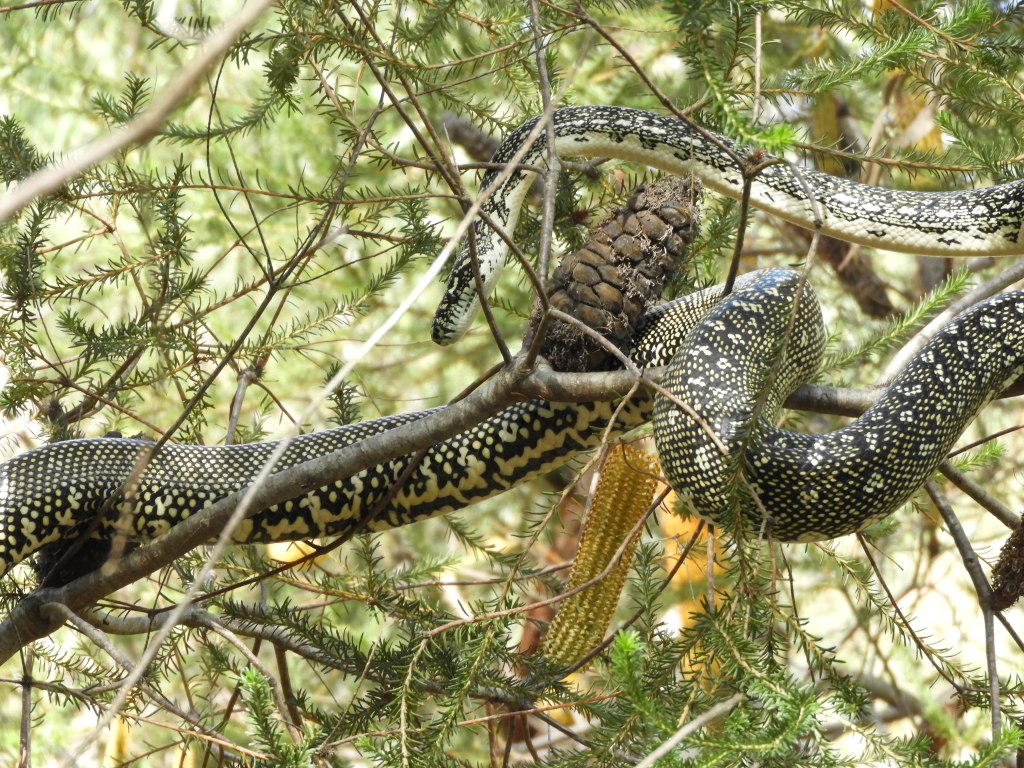
The markings on the snake’s skin are amazingly intricate. And such a gorgeous face:

The snake catcher said that the snake had been found on the roof of someone’s car in a nearby suburb. He’d been called to remove the snake, and Manly Dam park is a great place to release creatures like this.
Diamond Pythons are related to Carpet Pythons, and are native to the eastern coast of Australia (which is where I am). They’re the most southerly occurring python in the world. This one was about two metres long, I think. They can grow up to three metres.
Here’s a short video showing the snake’s lazy movement as it slides along the branches of the Heath Banksia tree:
Thank you to Chris Zabriskie for the video soundtrack:
What True Self, Feels Bogus, Let’s Watch Jason X by Chris Zabriskie is licensed under a Creative Commons Attribution 4.0 license. https://creativecommons.org/licenses/by/4.0/
Source: http://chriszabriskie.com/reappear/
Artist: http://chriszabriskie.com/
What about the birds, you may ask? Since this is primarily a blog about birds, where do they fit in? Diamond Pythons do eat birds, but their typical prey is small animals and reptiles. The python lies in wait for its prey, sometimes for days on end. Then the snake snatches the creature, wraps itself around it, and smothers it to death before swallowing it whole.


 Sydney Birder